Archive for January, 2011

adjective: practical

A little while ago, I wrote about the adverb “practically”. Today, I would like to write about the adjective form “practical”. You would think that they basically have the same meaning, but they don’t.

The adverb “practically” is usually used to mean “almost”, but the adjective “practical” is usually used when we want to describe a person or a thing as displaying useful thinking. When we describe a person as “practical”, it means they think about how things can be used for a useful purpose. When we describe a thing as being “practical”, it means that it can be used for a useful purpose. For example:

My daughter always carries a Swiss army knife in her bag. She’s so practical!

My husband is very good at thinking of various uses for old pieces of wood. He’s extremely practical in that way.

My mother always gives people very practical gifts like coffeemakers or can openers.

I don’t think I learned a lot of practical things in high school. My sister took home economics, and she learned more practical things like how to cook and sew.

My French teacher taught me how to say a lot of practical questions such as “Where is the bathroom?” and “How much is this?”

We can also use the word “practical” to talk about things that are connected to real life experience rather than theory. For example:

This new software will have a lot of practical applications.

I got a lot of practical experience by working as a waiter in a restaurant. I think I know more about the restaurant business than most people studying about it in school.

It is possible to use “practically” with this meaning but, in my opinion, it’s not so common. For example, it’s possible to say something like, “We must think about this practically.” However, I think most people would say, “We must think about this in a practical way.” To me, using “practical” sounds more natural.

grammatical word: almost

Today, I’d like to go over a word which my students usually use incorrectly: “almost”. I’m not sure about other languages, but in Japanese and Korean the word for “almost” has a slightly different grammar than it does in English. That is the reason why many people in those countries make mistakes when using it.

So, “almost” means “just less than” when talking about the quantity of something or the time. For example:

It’s almost 3:00 now.

The class is almost over.

There are almost 100 people who work in my department.

Almost 600 million people have gone to Disneyland since it first opened.

Almost all of the people at my company speak English well.

Almost everyone I know likes to watch movies.

Almost none of the people in my family have been overseas.

Almost nobody in the class could pass the test. I think only two people passed it.

So please note that if we use “almost” with a number, the number follows directly after “almost”. However, if we use “almost” with a noun such as “people”, we have to put another word between them; such words are often “all”, “every”, “no”, “none”, etc. We can also use it with words like “everyone” and “nobody”. However, we CANNOT say something like “Almost people in Japan like sushi.” Instead, we have to say something like:

Almost all people in Japan like sushi.

Almost every Japanese person likes sushi.

Almost everyone in Japan likes sushi.

The second way to use “almost” is when we want to talk about something which came close to happening but actually didn’t happen. For example:

My mother was in an accident. She almost died, but she’s going to be alright. 

My husband and I almost went to Italy for our honeymoon, but we decided to go to Hawaii instead.

Someone threw a rock at me. Luckily it didn’t hit me, but it almost did.

I was almost late for work today. I got to the office right at 9:00.

the difference between words: if and whether

Last week, one of my readers asked me to write about the difference between “if” and “whether”, so here it is.    🙂

We use “if” when we want to talk about imagining a certain situation. In these cases, “if” can be placed either at the beginning or in the middle of the sentence. For example:

If I won a lot of money in the lottery, I’d buy a big house and travel all over the world.

I’d buy a big house and travel all over the world if I won a lot of money in the lottery.

If I were you, I wouldn’t do that.

I wouldn’t do that if I were you.

If I decide to go out tonight, I’ll give you a call.

I’ll give you a call if I decide to go out tonight.

We can use both “if” and “whether” when we want to talk about the possibility of a certain condition being true or not. For example:

I need to find out if Ryan is coming to the party.

I need to find out whether Ryan is coming to the party.

I need to find out whether or not Ryan is coming to the party.

I need to find out whether Ryan is coming to the party or not.

Nancy didn’t tell me if she likes her new job.

Nancy didn’t tell me whether she likes her new job.

Nancy didn’t tell me whether or not she likes her new job.

Nancy didn’t tell me whether she likes her new job or not.

As you can see, we often use “or not” when we use the word “whether”. It’s not absolutely necessary for the sentence to make sense, but it’s a very natural way to speak. It can be placed after “whether” or at the end of the sentence.

Finally, we use “whether” when we want to talk about deciding between two or more options. It is possible to use “if” in these situations as well but, in my opinion, the word “whether” sounds more natural. For example:

Whether you go to university or not, I’ll always be proud of you.

If you go to university or not, I’ll always be proud of you.

I don’t know whether I should have the chocolate cake or the apple pie for dessert.

I don’t know if I should have the chocolate cake or the apple pie for dessert.

I hope that is clear to everyone and especially to my reader who requested it.

idiom: for someone’s days to be numbered

This week’s idiom is another interesting one. It is for someone’s “days to be numbered”. It means that the person’s life in a certain situation will not last forever and will probably end soon. For example:

My co-worker is extremely incompetent, so I think his days are numbered at our company.

There are many rumors of layoffs at my company. I was hired only a year ago, so I think my days are numbered there.

I think the fax machine’s days are numbered. Pretty soon everyone will just send information by computer.

Mr. Henrick’s days as our Prime Minister are numbered. He’s so unpopular; there is no way he’ll win the next election.

I’m afraid my days are numbered. I just found out that I’m dying.

So we often use it when talking about how long someone will stay at a certain company, as in the first two examples. In the first sentence, it means that the co-worker will probably soon be fired; in the second sentence, it means that I will probably be laid off soon.

In the third example, the expression means that the fax machine will no longer be used because it’s becoming outdated.

In the fourth example, it means that the unpopular prime minister will soon be out of office because there will be an election soon.

Finally, in the fifth example, it means that the person will die soon. This is obviously a more serious situation in which to use this expression. Therefore, we could use it about ourselves, as in “My days are numbered.”, but it would be very insensitive to use it about other people. However, you might hear something like that in a movie. For example, if a gangster plans to kill someone, he might say, “Your days are numbered!”

separable phrasal verb: use up

I have a nice and easy phrasal verb for you today, but it’s one which is very useful. It is the expression “use up”.  We use it when we want to talk about using all of something until there is none of it left. For example:

Peter used up all the toothpaste yesterday, so we have to buy some more today.

All the toothpaste has been used up, so we have to buy some more today. (passive voice)

We’ll probably use up all the toilet paper by the end of the week, so we should get some more.

I’m so tired right now. I was playing with my kids all day, and I used up all my energy.

Don’t use up all the gas in the barbeque. I need it to cook some steaks this weekend.

So we use this expression with items such as gas, toothpaste, and toilet paper, but we can also use it with non physical things such as energy (as in the fourth example). However, please note that we cannot use it when talking about food or drinks.

grammatical expression: God forbid…

I have an interesting expression today which seems very religious in nature, but actually it’s not. The expression is “God forbid…” We use it when we want to criticize someone else’s attitude about something. For example:

My husband really wants me to stay at home with him in the evenings. God forbid I should go out with a friend of mine!

My mother is always telling me to wear a long skirt. God forbid anyone should see my legs!

In the first sentence, the speaker is criticizing the attitude of the husband for not wanting her to go out in the evenings with any of her friends. In the second sentence, the speaker is criticizing the attitude of her mother for always wanting her to cover her legs.

We can also use this when another person doesn’t do something we think they should have done. For example:

We didn’t know how long we would have to wait in line. God forbid someone should come and tell us!

My family expects me to do all the cleaning in our house. God forbid they should help me!

In the first sentence, the speaker is criticizing the staff at the restaurant for not telling them how long they would have to wait. In the second sentence, the speaker is criticizing her family for not helping her clean the house.

Please note that with this expression we always use the word “should” in the sentence.

As I mentioned before, this expression seems very religious because of the use of the word “God”. However, most English speakers use it even if they are not Christian or Jewish. It has simply become a common expression and people usually no longer think about it as being religious.

adjectives: competent/incompetent


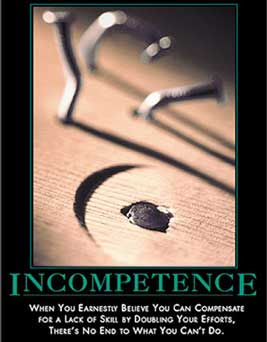
Today I’d like to write about the adjective “competent” and its opposite “incompetent”. These words are used to describe a person’s ability to do their job. If a person is able to do their job well, we say they are competent. On the other hand, if a person cannot do their job well and are constantly making mistakes, we say they are incompetent. For example:

Nathan is a very competent engineer, so I think we should ask him to lead this project.

A: Who’s the most competent person in your department?

B: I would say it’s Justin. He’s extremely competent at his job.

Paul is very competent when it comes to computer programming, but he’s not so competent when it comes to organizing the schedule.

Our company has a new president who’s completely incompetent. His bad decisions have cost our company a lot of money.

Jackie was fired yesterday because she was completely incompetent at her job.

I do all the cooking at my house because my wife is totally incompetent in the kitchen.

It’s important to note that we cannot use the word “competent” about jobs that are more artistic in nature because the word sounds very technical. Therefore, we would NOT say, “She’s a very competent artist.” Instead, we would choose a word with more emotion in it. For example, “She’s a wonderful artist.” or “She’s an amazing artist”. If we used the word “competent” in that situation, it would not sound like a compliment.

Also, if we simply say a person is “competent” at something, it doesn’t sound extremely positive. It’s like saying, “He has the required skills to do the job.” If we want it to sound more positive, we put words like “very”, “totally”, “completely” or “extremely” in front of “competent”.  Then it will sound much more positive.

Finally, please be careful not to use the word “competent” directly to another person. If we say “You are very competent at your job.”, it doesn’t sound very good because it’s very technical and there’s no emotion in the statement. Therefore, we always use it when talking about other people who are not there at the moment.

grammatical word: practically

Today, I’d like to talk about the adverb “practically” which is commonly used in English. It has the same meaning as “almost” but is a little more casual. Let me give you some examples:

I  have meetings at work practically every day.

My son is 18 years old now. He’s practically a man.

This cleaner is so effective. It can clean practically anything.

I ran in a marathon last week. It was so hard for me; I practically died.

In the case of the last sentence, this is an example of exaggeration. English speakers often do this in casual conversations. When the person says “I practically died.”, they don’t really mean to say they almost died. The true meaning is that they were extremely tired. Here are some other examples of exaggeration using “practically”:

That guy is so tall he’s practically a giant.

It was so windy yesterday my house practically blew down.

My cousin drives so fast. He practically breaks the speed of light when he’s driving.

the difference between words: suggest and recommend

Recently, one of my students asked me what the difference between “suggest” and “recommend” was. I thought that would make a good blog entry, so that’s what I’ll go over today.

We use “suggest” when talking about giving someone an idea in general, and we use “recommend” when telling someone that a certain choice or option is the best one. For example:

I suggest that you wear a nice suit tomorrow. The company president is going to be visiting the office.

If you want to cook delicious dishes, I suggest that you buy fresh ingredients.

My brother suggested a Greek restaurant for dinner tonight. What do you think?

I recommend that you try the chocolate cake for dessert. I think it’s the best dessert on the menu.

My friend recommended that we go to Spain for our vacation. He said it was the best country he’s ever been to.

The clerk in the bookstore recommended this book for people who are interested in Asian culture.

With the words “suggest” and “recommend” it’s very important to pay attention to the grammar because we often use a different verb tense called the subjunctive with these words. For example, many non-native English speakers say things like: “I suggest you to study economics.” or “I recommended my friend to try the apple pie.” These sentences are totally WRONG!

If you look at the example sentences I wrote above, you’ll see that the grammar is different. The grammar is as follows:

subject + suggest/recommend + that + another person + base form of the verb

It’s important to note that the verb which comes after “suggest” or “recommend” is always in the base form, even with “he” and “she”. That’s what makes this the subjunctive tense. We can also use this tense with the verbs “demand” and “insist”. Let me give you some more examples:

My friend wants to lose weight, so I suggested that he join a gym.

The waiter recommended that we not try the curry soup because it’s very spicy.

My customer demanded that I give him a refund.

My boss insisted that Pauline go home because she wasn’t feeling well.

Normally, we would say “he joins” or “Pauline goes” but, as I said before, we must always use the base form of the verb in these types of sentences.

However, if we put a noun directly after the words “suggest” or “recommend”, the sentence is not subjunctive. For example:

My brother suggested a Greek restaurant for dinner tonight. What do you think?

The clerk in the bookstore recommended this book for people who are interested in Asian culture.

idiom: to give someone a run for their money

I recently heard someone use today’s idiom at a party, so I’d like to write about it today. The expression is to “give someone a run for their money”. It is used when we want to talk about two people doing something which requires some skill. The main person is very good at it, but the second person’s skill is almost equal. The first person is still better, but the second person shows that their skill is almost as good. For example:

Carl is really getting a lot better at tennis. We played yesterday and I won, but he really gave me a run for my money.

Betty wins the baking competition every year, but this year I think I’ll give her a run for her money with my apple pie.

Everyone thinks The Storm by Martin Collins will win the best book prize this year, but the new book by Pauline Young will really give Collins a run for his money.

So far Germany has won 232 gold medals at the Olympics, but Italy is giving them a run for their money with 227 gold medals.

So we usually use this idiom when talking about games, sports or competitions. The idea is the favored person or team to win will have to work harder in order to stay in the lead position. They can’t just relax and assume that they will win for sure.

Next entries » · « Previous entries