grammatical expression: so much for

so-much-for--source

Today, I have another common expression that English speakers use in casual conversations: “so much for”. It is used when we want to say that something we were expecting to happen will not happen. It can also be used to indicated that something we thought was true is not true. For example:

It’s just started to rain! So much for our picnic!

The prime minister just announced a tax increase! So much for his promises not to raise taxes!

I just got laid off at work! So much for buying a new house this year!

A: Bill made a huge mistake and lost the company one of our biggest clients!

B: Well, so much for the promotion he was supposed to get.

The Shepherds only had two successful songs, and then the band broke up. So much for all the predictions that they would become as successful as the Beatles.

When we use this expression, the feeling is usually either neutral or negative. If someone uses this when they feel happy about the situation, it sounds as if they are gloating. So, in the fourth example, if the person who says “so much for the promotion he was supposed to get” is happy that Bill made a mistake, it sounds like that person either doesn’t like Bill or is in line for the same promotion.


adjective: fine

fine

Today, I’d like to write about a word that many of my students use but don’t fully understand: “fine”. Whenever I ask a Japanese person, “How are you?”, almost all of them reply, “I’m fine, thank you. And you?” Now technically this is correct, but native English speakers almost NEVER say, “I’m fine, thank you. And you?” Instead, we will say things like:

I’m great. How about you?

I’m good. You?

Pretty good. Yourself?

I’m not bad. And you?

Sometimes we say, “I’m fine”, but the above examples are more natural, in my opinion. However, if someone is concerned about our physical or emotional well being and asks us, “Are you ok?”, we often say “I’m fine.” to tell them that they don’t have to worry about us, and that we’re ok.

Now, there is another misunderstanding about “fine”. Generally speaking, when we say something is “fine”, the feeling is neutral, but not extremely positive. For example:

A: How was your day?

B: It was fine.

A: Just fine? Is there something wrong?

_______________________________________________________________

A: Did you enjoy the party?

B: It was fine.

A: Only fine? I thought it was really fun.

However, sometimes the word “fine” can have a much more positive feeling when we use it. These cases are more rare and sound a little old-fashioned. For example:

George is a fine man and you’re very lucky to have a husband like him!

It’s a fine ring that you bought your fiancee. I’m sure she’ll love it.

When we use “fine” in this way, we must stress the word “fine” in order to indicate that it’s very positive. Also, it’s important to note that when “fine” is used positively, it must come in front of a noun. Therefore, if we say, “The ring you bought your fiancee is fine.”, it sounds like we’re saying it’s just ok.

Finally, many of my students use “fine” to talk about the weather. For example:

The weather is fine today.

It’s a fine day today.

This is not natural in North American English, although I did hear people say things like that in Australia, so perhaps it’s more British English. In the United States and Canada, it’s more natural to use the word “nice” to describe good weather conditions. For example:

The weather is nice today.

It’s a nice day today.

So, I hope this clears up some of the misunderstandings about the word “fine”.

grammatical word: stop

images

Last week, I wrote about the different between “tried” + infinitive and “tried” + -ing. This week, I would like to do the same thing with the verb “stop”.

When we use “stop” + infinitive (“to” + base form of a verb), it means that we cease our current activity in order to do something else. When we use “stop” + gerund (-ing form of a verb), it means that we quit a certain activity forever. For example:

While I was driving to my hometown, I stopped to get something to eat.

I’m a little tired right now. Can we stop to relax for a few minutes?

A: Where’s Ben? I thought he was working.

B: He was, but he stopped to have a cigarette. He’ll be back in a few minutes.

Last year, my father stopped smoking. I’m so proud of him.

Would you please stop tapping your pen on the table? It’s really annoying!

My doctor tells me I should stop drinking so much beer, but I really love it!

The difference between these two forms is very important, so my suggestion is that you memorize the sentences and then change the small details to make new sentences. That way it will be less confusing for you, and the English structures will eventually become natural in your mind.

the difference between words: hear and listen to

listen-2

Last week, I went over the difference between “see”, “look at” and “watch”. Today, I want to go over the difference between “hear” and “look at” which is closely related to the post last week. The word “hear” means that we physically pick up sounds with our ears, but we are not focusing on those sounds. In this way, “hear” is similar to the word “see”. The term “listen to” means that we are focusing on those sounds. In this way, “listen to” is similar to “look at”. Here are some examples:

Didn’t you hear the phone ring? I’ve been trying to call you all day.

Can you hear that? It sounds like a baby crying.

I could hear a strange sound coming from my neighbor’s apartment last night. I wonder what he was doing.

On the weekend, I listened to music. I especially like to listen to old time rock and roll.

You have to listen to this joke! It’s so funny!

The doctor listened to my heartbeat and told me he thinks I have a problem with my heart.

The term “listen to” also has another meaning. It can also mean to pay attention to what someone says to you and to do what they say. For example:

I didn’t listen to my parents when they said I should go to university, and now I really regret that.

If you listen to what Frank has to say, you’ll be very successful at this company. He’s been here for a long time.

Listen to me! If you don’t stop smoking, you’re going to have a lot of health problems in the future!

So, that is how we use these words in English. I hope everyone has a great week!

idiom: to get/have cold feet

images

Today is Sunday, and that makes it idiom day! So today, I have an interesting expression for you: “cold feet”. We use this when we talk about a person who is really nervous about something that they are planning to do and is considering changing their mind about doing it. For example:

A: My wedding is tomorrow, and I’m really nervous about it!

B: I hope you’re not getting cold feet!

My brother agreed to make a speech at the conference but, at the last minute, he got cold feet and said he couldn’t do it.

A: You look really nervous about giving this presentation. If you have cold feet and don’t want to do it, I’ll understand.

B: No, it’s ok. I’m a little nervous, but I don’t have cold feet. I’ll do it.

I just heard that the Mark Jackson’s wedding was cancelled. I guess either Mark or his fiancee had cold feet and decided to call off the wedding.

This idiom is often used in situations to do with weddings and getting married, but it can be used in other situations as well. If we use it in the past tense, as in the second and fourth example sentences, it means that the person actually did actually cancel the plans because of being too nervous.

inseparable phrasal verb: live up to

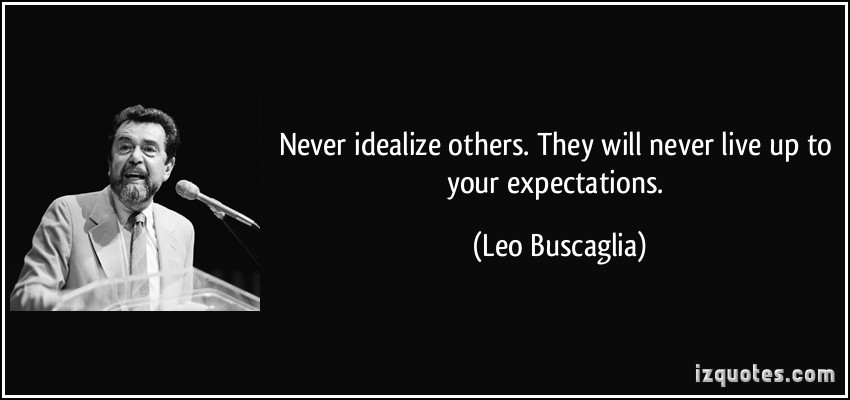
quote-never-idealize-others-they-will-never-live-up-to-your-expectations-leo-buscaglia-28273

The phrasal verb for this week is “live up to”. It’s an example of a three word phrasal verb. Another example of this that I’ve written about in the past is “come up with”. Almost all three word phrasal verbs are inseparable which means that the object, whether it’s a noun or a pronoun, will come after the third word (a preposition).

The phrasal verb “live up to” is used when we talk about a person who fulfills someone else’s expectations or follows their example. For example:

My father has such high standards for success. I could never live up to his expectations.

My father’s expectations for success can never be lived up to. (passive voice)

My mother is an amazing woman. I’ve tried hard all my life to live up to her example.

I really admire my teacher. I hope I’ve been able to live up to her expectations.

So, when we use this expression, the person whose expectations are trying to be lived up to must be someone in a high position in comparison with the speaker. Often it’s someone’s mother or father, but it’s possible to be another person as well. When using this expression, we usually DON’T say something like , “I lived up to my father’s expectations.” Instead, it’s more natural to use it in the negative. For example:

I didn’t live up to my father’s expectations.

We can also use it with the word “try”. For example:

I tried to live up to my father’s expectations, but I couldn’t.

I’m trying to live up to my mother’s example.

So, that’s the phrasal verb for this week. I hope everyone has a great weekend!

grammatical expression: of all (things), (people), (places)

index

There’s another very common short expression that native English speakers use a lot in conversation that I’d like to go over today: “of all”. It can be used in the following expressions: “of all things”, “of all people” and “of all places”. It is used to emphasize surprise or displeasure about certain things, people or places. For example:

I asked my girlfriend what she wanted to do on Saturday, and she chose to go skydiving of all things! I couldn’t believe it!

My husband gave me a present yesterday and, of all things, it was a kitten! I was so surprised!

A: Who did the boss give the promotion to?

B: It was Jack of all people! He’s only been with the company for six months! Everyone was surprised, including Jack.

I ran into someone at the supermarket yesterday and, of all people, it was my ex-boyfriend! It was very awkward!

My husband and I are trying to decide where to go on vacation and, of all places, he wants to go to Israel! I have no idea why he wants to go there!

In January, my boss is sending me on a business trip to Canada of all places! It’s going to be so cold there in January!

So, in the example sentences, the people are basically saying that of all the possible things, people or places in the world, this particular thing, person or place was chosen, and they are very surprised about that. The feeling is usually a little negative when people use this expression.

adjective: clumsy

images

Wednesday is adjective day. So today, I’d like to write about the word “clumsy”. In English, it has two meanings:

1. a person who has trouble controlling their physical movements and who drops things or falls down by accident. For example:

My sister is really clumsy. She’s always hurting herself by accident. Sometimes I worry about her.

I’m sorry for spilling wine on your carpet. I’m so clumsy today.

A: Who’s the clumsiest person in your family?

B: It’s my father. My mother won’t let him wash the dishes now because he often drops the glasses.

2. something that is badly constructed or made. For example:

The artist’s earlier paintings are quite clumsy in comparison with his later work.

Many of the sentences in your essay are clumsy and too long. I’d like you to rewrite them.

The construction company got a bad reputation because they did clumsy work on many of their previous buildings.

When we talk about a person being clumsy, sometimes it’s a general condition (as in the first and third example sentences), and sometimes it’s a temporary condition (as in the second example sentence). I think most people are clumsy sometimes, but only a few people are clumsy all the time.

grammatical word: tried

tumblr_ma42r7nSLZ1rrtahqo2_400

I have noticed a common misunderstanding among my students with the word “try”. As most people know, this word means to attempt to do something. However, when we use it in the past tense, it can have two different meanings. If we follow the word “tried” with an infinitive (to + base form of a verb), it means that we failed to do something that we were attempting to do. However, if we follow it with a gerund (-ing form of a verb), it means that we successfully did the thing we were attempting but that the result was not what we wanted. For example:

It’s really hot in this room. I tried to open the window, but I couldn’t.

It’s really hot in this room. I tried opening the window, but it didn’t work.

In the first sentence, the person made an effort to open the window, but it didn’t open. In the second sentence, the person was able to open the window, but it didn’t cool the room down. Here are some more examples:

I tried to quit smoking last year, but it was too hard for me.

I tried to call you yesterday, but the line was busy.

We tried to get a reservation at the new Italian restaurant downtown, but we couldn’t. It must be very popular.

I have a headache. I tried taking this medicine, but I still have it.

I need someone to work for me on Friday. I tried asking Bill, but he said no.

I have a lot of ants in my house. I tried using this bug spray to kill them, but it didn’t work.

Some verbs can be followed by either the infinitive or the gerund forms of other verbs with no change in meaning. For example, this is the case with words like “like”, “love”, “don’t like” and “hate”. However, other verbs can only take one form or the other, but not both. This is the case with the verb “enjoy”. We can say, “I enjoy exercising.”, but we CANNOT say, “I enjoy to exercise.”

the difference between words: see, look at and watch

lookat

Today I want to write about another confusion for many non-native English speakers: the difference between “see”, “look at” and “watch”.  Basically, the word “see” means that we can perceive something visually with our eyes; the term “look at” means that are focusing on something with our eyes; the word “watch” also means we are focusing on something but that it is moving, and we are following the movement with our eyes. Here are some example sentences:

I can see the sign for a Chinese restaurant down the street. Let’s have lunch there.

You were supposed to stop the car. Didn’t you see the stop sign?

I saw a really nice coat in the window of ABC department store. I want to buy it.

You should come and look at this picture. It’s really nice.

Don’t look at my face! I have a lot of pimples right now!

Just look at this room! It’s so dirty! We have to clean it up.

I watched a DVD with my friend last night.

I like to sit by the window at this cafe and watch people walking around outside.

My science teacher asked us to watch an experiment he was performing.

However, the verb “see” has a few other meanings which some people don’t realize. Here are some of them:

1. to date someone. For example:

I’m seeing someone now. We’ve been dating for six months.

2. to have a meeting with someone you already know. For example:

I saw my best friend last night. We had dinner at an Italian restaurant.

3. to find out some information that you don’t have. For example:

I don’t know when the delivery date is. I’ll go and see if my boss knows.

4. to watch a public performance. For example:

My friend and I saw a movie last night. We went to the new movie theater downtown. It was really nice!

So, if we watch a play or a movie in a theater, we use “see”, but if we watch a movie at home on TV or DVD, we use “watch”.

Newer entries » · « Older entries