the difference between words: overwork and work overtime

working_overtime

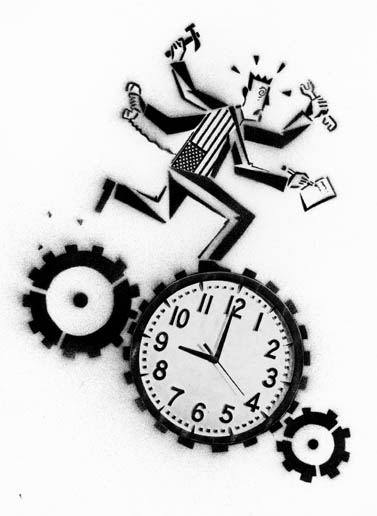
Today I’d like to go over another common misunderstanding that many of my students have: the difference between “overwork” and “overtime”. When someone works longer than their regular scheduled hours, we say that they “work overtime”. However, when someone is working too hard or too much, we saying they are “overworking”. Therefore, the word “overtime” is a noun, and the word “overwork” is a verb. Here are some examples of how to use them in sentences.

I have to work a lot of overtime right now because my company is in the middle of a huge project.

My boss asked me to work overtime tonight, so I won’t be able to have dinner with you. I’m sorry.

Ben looks so tired these days. He’s really overworking right now. He needs to take a break.

My husband has been overworking himself trying to get his business off the ground.

The term “work overtime” is neutral in meaning, but the word “overwork” is always considered negative because it means to work too much. Whenever we use “too”, the situation is always considered bad.

Please note that in my last example I used “overworking himself”. It’s very common to use words  like “myself”, “yourself”, “himself”, “ourselves”, etc. after the verb “overwork”. In these cases, it means that it’s the person’s choice to work extremely hard, but that it’s too much.

separable phrasal verb: put out

563442844

Today, I’d like to go over the phrasal verb “put out”. It has several meanings in English, so I’ll go over them for you now:

1. to extinguish something (usually a fire or a cigarette). For example:

Please put out the campfire before you go to bed. We don’t want to cause a forest fire.

The campfire has to be put out before you go to bed. (passive voice)

I told the man that his cigarette was bothering me, but he refused to put it out.

2. to publish something (usually a magazine or newspaper). For example:

This publisher is putting out a brand new magazine for women. They think it will be very popular.

A brand new magazine for women is being put out by this publisher. (passive voice)

The billionaire puts out several newspapers all over the country.

3. to cause an inconvenience for someone. For example:

My colleague was late for our appointment, so he really put me out.

My co-worker forgot to bring the materials for the presentation, so she put out the whole group.

4. to annoy someone. For example:

My girlfriend really put me out when she told me she didn’t like the present I gave her.

I was really put out when my girlfriend said she didn’t like the present I gave her. (passive voice)

It really puts me out when I hear people making racist comments!

5. to place something outside (often a pet). For example:

It’s time to go to bed. Can you put the cat out for the night?

The cat needs to be put out for the night. (passive voice)

Tonight we won’t put the dog out because it’s too cold.

6. to make an effort to do something (used with “an effort”). For example:

I notice that you’ve really been putting out an effort to improve sales. I appreciate your hard work.

My son has really been putting out an effort to improve his grades at school. I’m really proud of him!

The first five meanings are separable, but the last meaning is inseparable. With the meanings which are separable, please pay attention to what type of noun or pronoun is used. Some of the meanings talk about things and some of them talk about people.

the difference between words: slow and late

index

A while ago, I wrote about the difference between “fast” and “early” so, in today’s blog entry, I’d like to go over the difference between “slow” and “late”. I wrote in my earlier entry that “fast” is about the speed of something or someone and “early” is about the time something or someone arrives. In the same way, “slow” is also about speed, and “late” is about the time something or someone arrives. For example:

I’m sorry for being so slow to finish this report. I’ll get it to you as soon as I can.

The traffic was so slow on the highway yesterday! Under normal circumstances, it would have taken us two hours to get home, but yesterday it took six hours!

I’m going to hand in my report late. I’m really sorry about that.

The teacher was late for my class. That’s really strange because she’s usually right on time.

So, my first and third examples are both talking about the writing of a report. I use “slow” with the first example because I’m focusing on how quickly the person is working. I use “late” in the third example because I’m focusing on when the report itself will be given to the boss; in other words, when it will arrive on the boss’ desk.

So, we use “slow” when something or someone takes a long time to do something, and we use “late” when something or someone arrives after the scheduled time.

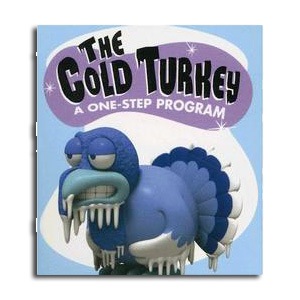
idiom: cold turkey

https://englishhelponline.me/wp-content/uploads/2011/08/cold-turkey.jpg?w=300

Today, I’d like to teach you another strange but interesting idiom. It’s the expression “cold turkey”, and we use it when we want to talk about quitting a bad habit suddenly instead of slowly trying to stop doing it. For example:

My friend quit smoking cold turkey. I don’t know how she could do that. She must have a lot of self control.

My father had to stop drinking cold turkey. His doctor told him if he drank any more alcohol, it would seriously harm his health.

A: How did you quit gambling?

B: I did it cold turkey. It wasn’t easy at first, but it got better after a while.

So, as you can see, we use this idiom in connection with the verbs “quit” or “stop”. I had to look up why we use “cold turkey” to talk about quitting something suddenly and there are no clear explanations, but one theory is that when someone quits using drugs or alcohol suddenly, their skin starts to look white with goosebumps on it. This is similar to the way turkey meat looks before it is cooked; in other words, when it is cold. I don’t know if this explanation is the true one, but it’s interesting.

adjective: dull

images

Yesterday I wasn’t able to write a blog entry. I’m afraid I’m getting quite busy these days and I won’t be able to write my blog as often as I have been.

Anyway, the blog entry for today is the adjective “dull”. This word has three meanings in English:

1. to be boring. For example:

The party last night was really dull. I wish I hadn’t gone.

My husband has become really dull recently. He never wants to go out and do anything anymore.

2. to not be sharp. For example:

This pencil is really dull. Do you have a pencil sharpener I can borrow?

My kitchen knives are so dull. I need to get them sharpened.

3. to not be shiny or bright. For example:

My kitchen floor is really dull right now. I need to polish it.

The colors in this painting used to be bright, but they have faded over the years. Now, as you can see, the colors are quite dull.

Some people think the word “dull” means “dumb” or “stupid”, but it doesn’t. Also, please note that this word can mean “boring”, but it doesn’t mean “bored”.

the difference between words: fast and early

https://i0.wp.com/www.jordandesilets.com/wp-content/uploads/2011/02/fast.gif

Today I’d like to write about the difference between “fast” and “early”. I don’t know about other languages, but in Japanese they use the same word for both ideas.

The word “fast” is used to mean that someone does something quickly. For example:

I can run very fast. I won many races when I did track and field in high school.

Paul works very fast. He completed his last project in less than two weeks.

Wow! You got here really fast! There must have been very little traffic.

The word “early” is used to mean that someone arrives ahead of the scheduled time. For example:

I came early for the party because I thought I could help you get ready for it.

I like to get to work early. It gives me a chance to do some things without having a lot of people around.

Spring is early this year. Normally it doesn’t begin for three more weeks.

If you have trouble understanding the difference between these two words, think about it like this: “fast” is about the speed of something or someone and “early” is about when something or someone arrives.

idiom: to dodge a bullet

http://softeuropean.files.wordpress.com/2009/01/dodge-a-bullet.jpg?w=419&h=279

Today’s idiom is to “dodge a bullet”, and it is used when we want to talk about a situation in which we didn’t get something we wanted and then we find out that we were lucky not to get it. For example:

I really wanted that job at ABC Company, but I didn’t get it. Anyway, I just found out that the guy who got the job has been transferred to Mongolia! I guess I really dodged a bullet.

I know you wanted to date George, but he wasn’t interested in you. I think you dodged a bullet because I heard he treats his girlfriends really badly.

A: My wife and I wanted to buy this house, but we didn’t get it.

B: Oh really? You guys really dodged a bullet. This house needed a lot of repairs, and it cost me a lot of money.

I couldn’t get time off work to go camping last weekend, but it was raining all weekend so I guess I dodged a bullet.

In case you’re not sure, the word “dodge” means to move quickly away from something so that it doesn’t hit you. We sometimes use this word when talking about a game called dodgeball. This is a game we sometimes played in school in which people would throw a ball at the people on the opposite team and, if they hit them, they were out of the game. Therefore, the people had to dodge out of the way of the ball.

inseparable phrasal verb: stand for

https://i0.wp.com/www.realeadership.com/images/reputation_branding.jpg

This week’s phrasal verb is “stand for”, and it has three different meanings:

1. for some initials to represent words. For example:

A: What does ASAP stand for?

B: It stands for as soon as possible.

My friend told me UFO stands for unidentified flying object.

2. to believe in and represent a certain ideal way of living. For example:

I believe that our prime minister stands for family values.

That company refuses to use cheap labor in poor countries. They really stand for honesty and integrity!

3. to tolerate something. For example:

My mother won’t stand for any swearing in her house. One time I said a bad word and she washed my mouth out with soap!

You’d better be on time for work. Our boss won’t stand for anyone arriving late.

The third way of using “stand for” is always used in negative sentences and usually with the word “won’t”.

grammatical expression: easier said than done

https://i0.wp.com/28.media.tumblr.com/tumblr_ld4tzwIlqV1qcf25xo1_400.jpg

Today I’d like to write about the grammatical expression “easier said than done”. It is used when we want to respond to someone who thinks a particular thing is easy, but you know that it’s not. For example:

A: If you practice hard, you’ll be able to win the piano competition.

B: That’s easier said than done. There are a lot of good pianists in the competition this year.

_________________________________________________________________

A: Making an omelette isn’t difficult. You just have to beat some eggs, add some cheese and vegetables and then cook them.

B: Well, for me that’s easier said than done. I’ve never made an omelette before.

_________________________________________________________________

A: I don’t understand why you can’t quit smoking. You just have to smoke one cigarette less every day.

B: You’re not a smoker, so you don’t understand. That’s much easier said than done.

So, as you can see, we usually use this expression when responding to someone else’s statement. Even though we say it directly to the person, it’s not considered rude to say this.

adjective: appetizing

https://englishhelponline.me/wp-content/uploads/2011/07/broil1.jpg?w=300

Today’s adjective is “appetizing” and is used to describe food. However, we don’t use it to talk about the way food tastes. In that case, we would say “delicious”, “good”, “excellent”, etc. We use the word “appetizing” to say that a certain food looks, smells or seems delicious before we eat it. For example:

Look at the pizza at the table next to us. It looks really appetizing so I’d like to order the same thing.

My friend described this amazing recipe for lemon chicken that she made last night. It sounded really appetizing, so I got the recipe from her and I’m going to make it this weekend.

Durians don’t smell very appetizing, but they taste really good.

A: Here try some of this. It’s really good.

B: Well, frankly, it doesn’t look so appetizing. I don’t think I’d like it.

So, as you can see from my examples, we can use “appetizing” in both positive and negative sentences. Please remember that we can’t use this word after a person has eaten something; it’s only about the perception they have of the food before they eat it.

Newer entries » · « Older entries