Archive for March, 2010

the difference between words: until and by

deadline_clock

There is a common misunderstanding in Japan and Korea (and possibly in other countries as well) about the difference between “until” and “by”, so I’d like to explain the difference today. The word “until” refers to the time when some action stops, but the word “by” refers to a deadline when an action must be stopped. For example:

I worked until 8:00 p.m. last night.

I’m going to keep my part-time job until I graduate from university.

I’ll be in Osaka until Thursday, and then I’ll go back to Tokyo.

You can borrow my CD, but please give it back to me by the end of the month.

This project must be completed by Friday, March 26th.

A: What time do I need to check out of my room by?

B: By 11:00 a.m. please.

We also use “by” in the expression “by the time…” which is similar in meaning to “when”.  For example:

By the time I got to the office, the meeting had already started.

I had already finished my work by the time the boss called me.

Everyone had already started eating by the time I arrived at the restaurant.

By the time you get this message, I will already have left the office.

By the time I’m 50, I will have started my own company.

These last examples are a little bit more difficult because they use more complex tenses (had + pp and will have + pp). If you feel uncomfortable using them, try using the method I explained in my first blog: memorize the examples and then change the small details of the sentences to make new sentences. The important thing is that you don’t think in your native language. If you start thinking in your native language, you’ve changed the sentence too much! Good luck!


inseparable phrasal verb: own up to

??????????????????????????

Today’s phrasal verb is “own up to” and it is inseparable. This phrasal verb means for someone to admit to a bad thing they have done. The bad thing could have been done on purpose, or it could have been an accident; it doesn’t matter. For example:

I know my brother stole money from my wallet, but I’m sure he’ll never own up to it.

Someone broke the photocopier at the office. We didn’t know who did it, but finally Rex owned up to it and apologized.

I know it was you who stole my idea and gave it to the boss! Why don’t you just own up to it?

As you can see, we usually use this phrasal verb by explaining the bad situation first, and then talking about the person who admits to causing it.

idiom: off the top of one’s head

zo

Today, I have another idiom for you: off the top of one’s head. This is used when we say something without having the chance to really think about it before. It is usually used when talking about suggestions, ideas or when answering a question. For example:

A: Do you know of any good French restaurants in this area?

B: I can’t think of any off the top of my head, but there might be some.

________________________________________________________________

A: I don’t know of any good people in our company for the position of HR manager.

B: Really? Off the top of my head I can think of at least five people, and I’m sure there must be a lot more.

________________________________________________________________

A: What color do you think we should paint the living room?

B: Off the top of my head I would say green, but maybe we should think about it a little more.

________________________________________________________________

A: Do you know what  the capital of Spain is?

B: Off the top of my head I’d say Madrid, but it could be Barcelona. You’d better look it up on the Internet.

As you can see, this idiom is usually used as a response to someone’s question. Also, we almost always use it when talking about ourselves so we say “off the top of my head”, rather than “your head”, “his head”, etc.

grammatical word: unless

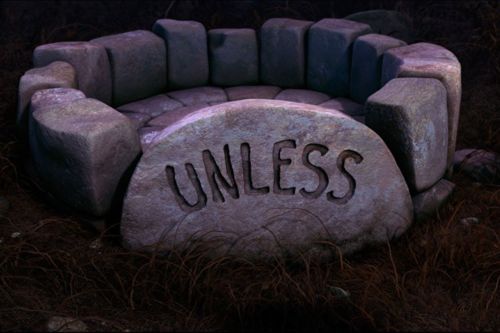
unless

Today, we’re going to go over the word: unless. This particular word is very difficult for my students to use correctly even when they understand the meaning. That is why I’d like to write about it today.

Basically, “unless” means “if not” but that definition doesn’t help people to use it in conversation. So here are some examples:

I won’t go to the party unless you go with me. (The meaning is – I won’t go to the party if you don’t go with me.)

You won’t pass the test unless you study hard. (The meaning is – You won’t pass the test if you don’t study hard.)

We won’t get to work on time unless we leave right now. (The meaning is – We won’t get to work on time if we don’t leave now.)

I will get to the restaurant at 9:00 unless I get lost. (The meaning is – I will get to the restaurant at 9:00 if I don’t get lost.)

I won’t buy a new suit unless it’s not expensive. (The meaning is – I won’t buy a new suit if it’s expensive.)

I will go to the picnic unless it’s really far away. (The meaning is – I will go to the picnic if it’s not far away.)

I can’t operate this computer unless someone shows me how to do it. (The meaning is – I can’t operate this computer if no one shows me how to do it.)

I can buy a new car next year unless I lose my job. (The meaning is – I can buy a new car next year if I don’t lose my job.)

So as you can see from these examples, the second part of the sentence will be turned from positive into negative or from negative into positive by using the word “unless”. Also, you can see that usually the first part of these sentences begins with  either “I will” or “I won’t”, but “I can” and “I can’t” are also used sometimes.

separable phrasal verb: cough up

xd

Today, I’d like to write about the expression: cough up. This has two meanings in English:

1. to produce something by coughing (often blood). For example:

My friend was so sick yesterday that he was coughing up blood.

2. to give something to someone. In this case, it is usually used in the imperative tense. This expression is a little bit slang. Also, if we say this to another person, it’s a little strong. For example:

I want the money you owe me now, so cough it up!

You owe Nancy $100. If you don’t cough it up soon, she’s going to be really angry.

the difference between words: can you, could you and would you

zh

Tonight I had dinner with one of my Japanese friends and he suggested I write about the difference between the words “can you”, “could you” and “would you”. So that is what I’m going to do.

In terms of formality, “can you” is the most casual, “could you” is more polite and “would you” is the most formal and polite. There is no major difference in meaning between “can you” and “could you” except that “could you” is more polite. However, there is a difference in nuance between “could you” and “would you”. The words “could you” focus on the ability to do something, but the words “would you” focus on the willingness to do something. For example:

Can you help me with my homework later? (said to a friend or family member)

Could you tell me how to get to the train station from here? (said to a stranger on the street)

Would you lend me your car this weekend? (said to a friend or family member, but in a very polite way because you want something from them)

Sometimes people get confused between the difference between “could you” and “would you” but there is one example sentence which usually helps people to understand. If a man is asking someone to marry him, he would say:

Would you marry me?

But he would NEVER say:

Could you marry me?

By saying, “Would you marry me?” he is asking “Are you willing to marry me?” but if he said “Could you marry me?” it sounds like “Do you have the ability to marry me?” (which sounds quite strange and VERY unromantic.) Here are some other examples for you to study:

Can you drive me to work today? My car isn’t working now.

Could you tell me how long I’ll have to wait until I can see the doctor?

Would you please stop tapping your foot? I’m trying to study.

So I hope this helps people to understand the difference between these words.

idiom: to ring a bell

zy

Today I have an idiom for you which is not related to a part of our bodies: to ring a bell. We use this to talk about something which we can remember a little but not clearly. For example:

A: Do you remember a guy named Martin Fisher?

B: The name rings a bell, but I don’t remember him very well.

________________________________________________________________

A: I watched an old movie last night called “Goodbye Mr. Chips”. Have you seen it?

B: Well, it rings a bell, but I’m not sure if I’ve seen it or not.

We can also use this expression in the negative: to not ring a bell. In this case, it means that we don’t remember ever hearing about something or someone in the past. For example:

A: Have you ever heard of “Blue Monday”? They were a rock band in the sixties.

B: Sorry, that doesn’t ring a bell.

________________________________________________________________

A: I ran into our old classmate, Patty Shelton, at the shopping mall today.

B: Patty Shelton? Are you sure I’ve met her? The name doesn’t ring a bell.

This is a very commonly used idiom among English speakers. I hope you find it useful.

grammatical expression: (just) in case

zb

Today, I’d like to explain another short expression that we often use in English: “in case”. We also can say “just in case” in some situations. We use this expression when we are talking about doing something as a preparation for a possible negative future situation. For example:

I brought my umbrella today in case it rains.

I brought a sandwich for you in case you were hungry.

I brought two pens with me to class in case one of them runs out of ink.

You should take your credit card with you on your trip in case you spend all your cash.

As you can see, we often use the words “bring” or “take” in these sentences. In these sentences the person brings something with them (the umbrella, the sandwich, the extra pen, the credit card) in order to prepare for a negative thing that COULD happen (it rains, the friend is hungry, the first pens runs out of ink, the person spends all their cash). It is important to note that the negative event is only a POSSIBILITY, and the person realizes that it might not happen.

We can also use “just in case” with these sentences, but the structure will change a little. For example:

It might rain today, so I brought an umbrella just in case.

I thought you might be hungry, so I brought you a sandwich just in case.

My first pen might run out of ink, so I brought a second one just in case.

You might spend all your cash on your trip, so you should take your credit card just in case.

We can also use “in case” or “just in case” when talking about preparing for a situation which is not negative but is unlikely or unexpected. For example:

I know the cherry blossoms probably aren’t going to be in bloom today, but I brought my camera in case they were.

I know the cherry blossoms probably aren’t going to be in bloom today, but I brought my camera just in case.

I hope this is clear to everyone. These expressions can be difficult to use so, as I’ve said before, please study the full sentences and memorize them, so you will be able to use them in conversation.

separable phrasal verb: chase down

woman-looking-for-something

Today,  I have another phrasal verb for you: chase down. This means to go and find a thing or person for someone else. This is often used in office situations. For example:

I can’t find Bruce anywhere, and I need to talk to him. Could you chase him down for me?

A: We need another copy of the report.

B: Ok, I’ll chase one down for you.

With this phrasal verb, the person who does the “chasing down”  is of lower status. So, a person of high status can ask a person of lower status to chase something or someone down for them, but a person of lower status can never ask that of a more important person. So please don’t ask your boss to chase anything or anyone down for you; he or she will not be happy with you!

adjective: patient

day 10

Today I’d like to start a new section for my blog: adjectives. Many people in Japan and Korea (and probably other countries also) use their electronic dictionaries to find the meanings of adjectives. THIS IS A BAD IDEA!!!! Adjectives are very nuanced and often they are used in ways in English that are different from the ways they are used in other languages. Therefore, you should ALWAYS use an English-English dictionary when trying to understand adjectives.

The adjective “patient” is a very good example of this. In English, it has two meanings:

1. to tolerate a situation you don’t like calmly (this is the same meaning as “gaman” in Japanese). For example:

Your father is getting old now and he forgets many things. You need to be more patient with him.

My sister is a great mother. She’s always patient with her kids even if they misbehave.

(Please note that  the word “patient” is followed by the preposition “with” in these cases.)

2. to be able to wait for something calmly. (Please note that this is the MAIN definition of this word in English.) For example:

The economy will get better. We just have to be patient.

I hate it when I have to wait for people who are late. I’m not patient at all in those situations.

The new Johnny Depp movie won’t come to Japan for another six weeks! I guess I’ll just have to be patient.

A: Where is the pizza? I ordered it over 40 minutes ago!

B: Just be patient. I’m sure it will be here soon.

So I hope everyone now understands the meaning of “patient”. I will go over other adjectives in future blogs as well but, as I said before, please use an English-English dictionary for them when you study on your own.

Next entries » · « Previous entries