Archive for adjectives

adjective: picky

?????????????????????????

The adjective for this week is “picky”. It is used to describe people who are hard to please about something, so they are very selective about it. For example:

My best friend is such a picky eater. There are so many things that he refuses to eat.

Evelyn is extremely picky when it comes to men. That’s why she’s usually single.

I’m very picky about the people that I hire for my company. They must all be well-educated and have a good personality.

We can also use “picky” to talk about someone who is very focused on the details of a situation. For example:

My French teacher is very picky. She corrects even the smallest mistakes that the students make.

When you make your business cards, make sure you select a good font. Some people think it’s a picky detail, but I think it’s very important.

In the case of the second meaning of “picky”, we can use it to talk about the person or the detail. However, in the first meaning, we only use it to talk about the person. In both cases, the word is a little negative in tone. We can say, “I’m picky.” and that’s ok because we are talking about ourselves, but if we say, “You’re picky.”, it’s a little rude and some people might get upset.


adjective: hot

index

In English, the adjective “hot” has many meanings which are often used in casual conversation. Let me go over the commonly used meanings for you in today’s blog.

1. for the weather to have a high temperature. For example:

It’s really hot today. It must be at least 40 degrees!

I don’t like hot weather very much, so I don’t enjoy the summers here.

2. for an object or food to have a high temperature. For example:

Don’t touch that pot with your bare hands. It’s really hot and it could burn you.

The soup is really hot because it just came off the stove. I need some water.

3. for some food to be very spicy. For example:

Those peppers are extremely hot, so I wouldn’t eat them if I were you.

Korean food is really hot and spicy, but I love it!

4. for something or someone to be very popular at the moment. For example:

Peter Nelson is one of the hottest young actors in Hollywood now! His last two movies were very successful.

The AB-40 computer system from ABC Computers is very hot right now! Everyone wants to get one!

5. for a person to be very sexy and attractive. For example:

Look at that girl over there! She’s so hot! I’m going to go over and talk to her.

Jayne’s boyfriend is really hot! She’s such a lucky woman!

6. to experience a lot of good luck when playing a game. For example:

I’ve won $700 at the casino so far! I’m really hot tonight!

I am hot at this game today! I’ve won every game so far!

7. something that has been stolen. For example:

A guy offered to sell me a car really cheaply, but I didn’t buy it from him. I have a feeling that it’s hot.

Pawn shops probably have a lot of hot items. I think a lot of thieves steal things and then pawn them as soon as possible.

All of these meanings are commonly used, but the last one about stolen items is probably the least commonly used in everyday conversation. However, this is the type of language that we often hear in movies or on TV shows.

adjective: dead

311e906b5d15be871e7bb23413e50c443d110f9c2e4691804cd2328a16796b20

I think everyone understands the main meaning of the adjective “dead” which is for someone or something to no longer be alive. However, many people don’t know that we can use the word “dead” in other situations. Let me go over them for you now.

1. for a place such as a restaurant or bar to not have many customers. For example:

The bar was dead on Saturday night, so we didn’t stay long.

The restaurant where my sister works has been really dead recently. She wants to find another job.

2. for a business deal to be cancelled. For example:

Our business partners backed out of our deal, so now it’s dead.

I thought our merger with ABC Company was dead, but they just told us they want to go ahead with it.

3. used to express that someone is in trouble with another person. For example:

I just broke my mother’s favorite vase! I’m dead when she gets home!

It’s because of Jim that we lost our biggest client! He is so dead when the boss finds out!

This last meaning of “dead” is only used in casual conversations because this meaning is a little bit slang.

It’s also important to know that when we use “dead” in the normal sense of someone or something losing life, we use the present tense, but not the past tense. For example:

My grandfather is dead now. He died about five years ago.

We CANNOT say: “My grandfather was dead.” because that would mean that he is alive again! Sometimes we say “was dead”, but only when the grammar demands it, such as when we use reported speech. For example:

Martin said his grandfather was dead.

So, these are the common ways to use the adjective “dead”.

adjective: bitter

bitter-beer-face

Most people know the word “bitter” refers to the taste of something being strong and unpleasant. However, there are other meanings which many people don’t know about. That’s what I’d like to write about today.

There are three basic meanings for the word “bitter”. Let me go over them for you.

1. the taste of something which is strong and unpleasant. For example:

This coffee is really bitter. I’d like to get another cup please.

I don’t like the taste of this vegetable. It’s really bitter, and it tastes like medicine.

2. something that is very strong in a negative way. It’s often used to talk about cold weather, the truth or a struggle. For example:

I hate the bitter winters in my hometown.

I really hate the weather in my hometown in the winter because it’s bitterly cold.

I know you’re having a hard time dealing with your divorce, but you have to get over it. The bitter truth is that your husband doesn’t love you anymore.

There is a bitter struggle going on right now between various leaders to see who will become president.

3. used to describe a person who remains angry about something for a long period of time. For example:

My father got fired from his job about a year ago, and he’s still bitter about it.

My friend is a bitter woman when it comes to men. She has had her heart broken many times, and now she hates men completely!

In the second definition, I used the word “bitter” as an adverb – “bitterly” – in front of the adjective “cold”. This is a special case though; we don’t use “bitterly” with most other adjectives. Let me give you some other examples of how it can be used.

It was bitterly painful to see my ex-husband with another woman.

The war between the two countries was bitterly fought.

The smell of sulfur is bitterly pungent.

There are probably other examples of how to use the word “bitterly”, but these are the main ones I could think of for natural conversations. However, you might see it used in novels but, in those cases, it’s not natural for conversational English.

adjective: gorgeous

457487-bigthumbnail

Today,  I have a word that is commonly misunderstood in Japan: “gorgeous”. Many people, in Japan at least, think it contains the meaning of being expensive, but this is not true. In English, it means that someone or something is extremely beautiful, and that’s all. For example:

My friend’s girlfriend is gorgeous. I wish I could find a woman as beautiful as she is.

The view from the top of Mount Fuji was absolutely gorgeous. I’ve never seen anything more beautiful in my life.

A: The hotel we stayed at in Rome was just gorgeous.

B: Oh really? Was it expensive?

A: Not too much. We were really lucky.

If we want to use a word that contains the meaning of being expensive, we can use the adjective “luxurious”. So if we say a place is luxurious, then it’s almost always going to be expensive and beautiful.

In the first example, a woman is being described as “gorgeous”, but we can also describe a man as “gorgeous”. For example:

Look at that guy over there! Isn’t he gorgeous!?

In these cases, the speaker will almost always be a young female such as a teenage girl or a woman in her 20s. Older women don’t usually describe a man as “gorgeous”. Instead, they will say he is “handsome”, “good-looking” or “attractive”.

adjective: hilarious

50ec7a48-e62d-4021-91d5-2ccf4a1427a2

The adjective for this week is “hilarious”. It is used to describe a person, a thing (such as a joke or a movie) or a situation as being extremely funny. Just as a reminder, the word “funny” is only used when we laugh at something, not when we find it interesting. Here are some examples using the word “hilarious”:

That new Jim Carrey movie was hilarious. I haven’t laughed that much watching a movie for a long time.

My best friend just told me a hilarious joke. Do you want to hear it?

I love hanging out with Wayne! He’s such a hilarious guy. He always cracks me up.

At the party last night, Nancy and Cheryl were both wearing exactly the same dress. They were both really embarrassed, but I thought it was hilarious.

It’s important to note that when we use this word, it’s already very strong in meaning, so we DON”T say: “very hilarious”; we simply say “hilarious”. Also, it sounds unnatural to say, “not hilarious”. Instead, most people would say, “It wasn’t funny at all.”

In the third example, I use the phrasal verb “crack up”. This means to make someone laugh. If you want more examples of this expression, you can check my blog entry for March 29, 2010.

adjective: cheesy

thats_sooo_cheesy_card-p137719651778285939q6ay_400

The adjective I have for you today is a rather young word. I would say that people only started saying it in the last 30 years or so. The word is “cheesy”, and it is used when we want to talk about some kind of entertainment which is of poor quality and makes people laugh although that is not the intention. For example:

I don’t like movies directed by Bruce Walters because the dialogue in them is really cheesy.

I’m not a fan of the singer Tom Johnson. He wears ridiculous clothes and platform shoes. Also, he sings in a really cheesy way. I can’t stand him.

People in India really enjoy Bollywood movies, but the films seem kind of cheesy to people outside of India.

I  like the old Batman TV show. It was incredibly cheesy, but it was fun.

For the most part, the word “cheesy” is negative, but it can be neutral in meaning sometimes, as in the last example. In this case, the person thought the cheesiness of the show was fun. However, even though the person thought it was fun, they would still consider the show of lower quality if they called it “cheesy”.

adjective: controversial

images

Today’s adjective is one which you’ve probably heard a lot if you watch the news in English: “controversial”. It is used when we want to talk about a public debate about something or someone in which the two sides have very different opinions. For example:

Bill Parker’s new book about religion is very controversial. Many people love it, but religious groups are extremely upset about some of his statements in the book.

The government’s decision to stop all immigration has been very controversial. Many people have protested the decision.

The Cove is a very controversial movie in Japan. Some people want to have it shown in Japanese movie theaters while others are very much against that.

When we use this word to describe things like books and movies, the difference of opinion has to be very emotional and strong. If  people simply disagree about a movie’s or book’s quality, we don’t say it’s controversial in those cases.

adjective: tentative

tentative_appt_sample

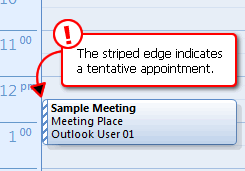
This week’s adjective is “tentative”. It is used when we want to talk about plans or appointments which have been scheduled but are not definite. In other words, they could change, but we aren’t sure yet. For example:

I have a tentative appointment with Bill Carson from ABC Company tomorrow at 3:00 p.m. He said he’d call to confirm it sometime this afternoon.

A: Would you like to have dinner with me tomorrow?

B: I have tentative plans with my friend to have dinner tomorrow night. Let me call her to find out if she still wants to do that.

________________________________________________________________

A: Why don’t we get together on Tuesday?

B: I’m supposed to play golf with my boss on Tuesday, but it’s only tentative. I’ll find out for sure and then let you know.

We can also use this word as an adverb by adding “-ly” to the end. For example:

A: What time can you meet with me on Friday?

B: I’m very busy that day. Let me see. Let’s make it tentatively for 2:00 p.m. I’ll confirm that time with you later.

This adjective is often used in business situations, but it can also be used when talking about personal plans in your free time.

adjective: sure-fire

images

The other day, one of my students was asking me about the adjective “sure-fire” and how to use it properly, so that’s what I’d like to write about today. The word “sure-fire” is used to describe a way of doing something that is guaranteed to work. For example:

One sure-fire way to get fired is to punch your boss in the face.

If you have the hiccups, you should hold your nose and drink water at the same time. It’s a sure-fire way to get rid of them.

Do you know any sure-fire ways to make a lot of money quickly? I really need some money to pay for my school.

I just bought a book about how to lose weight. They claim it’s a sure-fire method to lose at least ten kilos.

Generally speaking, the adjective “sure-fire” is placed in front of a noun (usually “way” or “method”). It’s possible to say, “This method is sure-fire.” or “That way is sure-fire.”, but it doesn’t sound very natural. The most natural way is to put “sure-fire” in front of the noun. Also, it’s important to note that the situations are usually positive but can also be negative, as in the first example about getting fired. In this sentence, it sounds like the person is making a joke about how to get fired.

Next entries » · « Previous entries