Archive for grammatical expression

grammatical expression: can’t help/couldn’t help

MV5BMTYyMDQyNzgxNV5BMl5BanBnXkFtZTcwNzIwOTI0MQ@@._V1_SY500_SX355_

Have you ever heard the old song “I can’t help falling in love with you”? Elvis Presley did the most popular version of it. Have you ever wondered what “can’t help” meant? Well, today that is what I’m going to write about.

The expression “can’t help” means that a person cannot control some kind of behavior that they do. So, in the case of the song, Elvis meant that he cannot control his feelings of love for the other person; he fell in love because he had no choice.

Here are some more examples:

You shouldn’t tease Rachel because of her acne. She’s a teenager, and she can’t help it if she’s got pimples.

Your uncle can’t help walking with a limp because his leg was injured in an accident a long time ago.

I got the hiccups during my exam, and I couldn’t help making a little noise.

I couldn’t help being late today. The trains were delayed for a long time because of an accident.

The first two examples use “can’t” because the situation which the person can’t control is still happening. The last two examples use “couldn’t” because the situation is now over.
grammatical expression: in the meantime

In The Mean TIme mob base

Last week, one of my readers asked me to write about the expression “in the meantime”, so I will do that today.

This expression is used when we want to talk about the period of time between two events. The first period of time can be now or a certain date or time; the second period of time is when something is supposed to happen. For example:

You can cut up these vegetables. In the meantime, I will start making the sauce.

I will start my new job at an international company in two months. In the meantime, I plan to study a lot and improve my English skills.

The party was supposed to start at 7:00, but I arrived in the area at 5:00 so, in the meantime, I went to a cafe and read a book.

A: Our work finishes at 6:00, but the office dinner doesn’t start until 7:30! What are we supposed to do in the meantime?!

B: Let’s just have a beer at the bar near the office.

As you can see, this expression can be used to talk about the past, the present or the future. In the case of the first example, the period of time that “in the meantime” is referring to is the time the person starts cutting up the vegetables, and the time they finish doing that. In the second example, the first period of time is now, and the second period of time is two months from now when the person starts their new job. In the last two examples, the periods of time are quite obvious because the person mentions exact times: between 5:00 and 7:00 (third example) and between 6:00 and 7:30 (last example).

grammatical expression: to say the least

logo

Today is my 200th blog entry!!!! I can’t believe it! Where did all the time go? I want to thank my readers for all your nice comments, and I hope to continue writing this blog for a long time.

Anyway, for today’s blog entry, I would like to write about another common expression: “to say the least”. It is used when we want to indicate that a certain word isn’t strong enough to describe a situation. For example:

My sister just won $100,000 in the lottery. She’s really happy, to say the least!

Thank you for giving that doll to my daughter. She loves it, to say the least!

There are many good-looking people in Italy, to say the least!

A: Well, that was a very strange movie.

B: Yeah, to say the least. I haven’t seen such a weird movie in a long time.

_________________________________________________________________

A: Would you say Charlie is a serious person?

B: Oh yes, to say the least. He never laughs or even smiles.

So, by using “to say the least” in these sentences, we’re saying that the words “happy”, “love”, “strange” and “serious” don’t go far enough in describing the situation. However, instead of adding “really, really, really, really” to the beginning to emphasize the word, we use “to say the least” at the end to emphasize it.

As you can see from the examples, we usually use this expression in sentences with adjectives, but sometimes we can use it with verbs such as “like”, “love”, “hate”, etc. We can also use it when talking about the quantity of something, as in the third example about how many good-looking people there are in Italy.

grammatical expression: easier said than done

11494842-blackboard-writings--easier-said-than-done

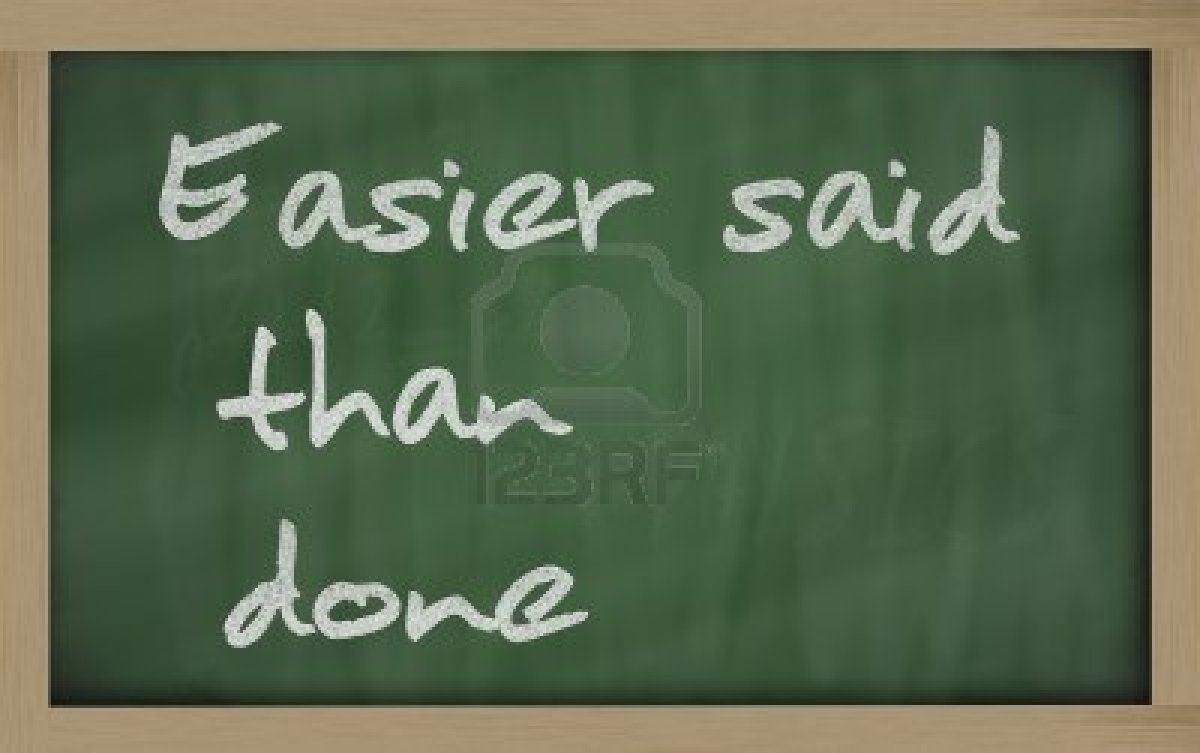
Today’s expression is “easier said than done”, and the meaning is probably quite obvious to you. It is used when we talk about accomplishing something which is easy to talk about but difficult to do. For example:

My doctor told me I have to quit smoking. That’s easier said than done. I’ve tried to quit before, but I couldn’t.

A: All you have to do to get into ABC University is get an A in your math course.

B: Well, that’s easier said than done. I’m not very good at math.

______________________________________________________

A: The city government needs to fix all the problems with the roads. There are so many potholes!

B: That’s easier said than done. There isn’t much money in the budget now, and there are many other problems that need to be solved as well.

This expression is often used as a response to another person’s statement, as in the last two examples. It’s a very common and useful expression, so I hope you’ll be able to use it now.

grammatical expression: as if

As-If

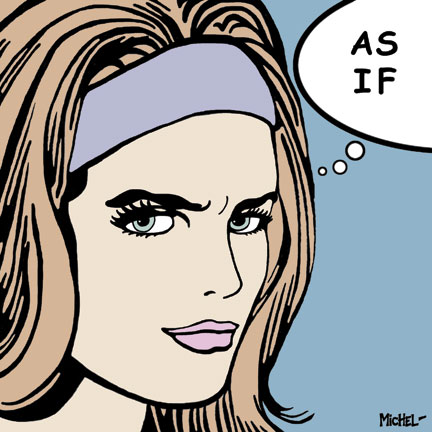
We often use the word “if” in English, and I think most people understand it well. However, by adding the word “as” to it will change its meaning. The expression “as if” is used when we want to express rejection of an idea or statement. It’s like saying that a certain idea or statement is impossible. For example:

A: You’re not really going to join the army, are you?

B: I was kidding! As if I would really do that!

_________________________________________________________________

A: Did you hear the latest gossip about Paris Hilton?

B: As if I care about Paris Hilton! I have more important things to think about.

_________________________________________________________________

A: John said he was going to buy a BMW!

B: I doubt that! As if he has enough money for a car like that!

_________________________________________________________________

A: Is Sharon coming to your party?

B: Are you kidding? As if I’d invite her! She stole my boyfriend last year, remember?

As you can see, it’s usually used as a response to what someone else is saying, and is used to reject the other person’s idea or statement. This expression can sound a little strong when we use it, so it should only be used in casual conversations with friends and never in formal situations or with people of higher status.

grammatical expression: if you don’t mind my asking

21slid4

Many of my students ask questions in English which are very direct and about things that are very personal to some people. These questions are often about things such as money, age or weight. They can also be about personal relationships. Some people are comfortable talking about these things, and some people are not. If you want or need to ask a person about these things, it can seem very rude. One way to soften the question is to add “if you don’t mind my asking” at the beginning. For example:

If you don’t mind my asking, how old are you?

If you don’t mind my asking, how much rent do you pay for your apartment?

If you don’t mind my asking, how much money do you earn?

If you don’t mind my asking, how much do you weigh?

If you don’t mind my asking, are you satisfied with your marriage?

As you can probably imagine, many people would be shocked by such questions, but they seem less direct if you add “if you don’t mind my asking” at the beginning. Now, the person who is being asked can respond in a positive way. For example:

No, I don’t mind. I’m 47 years old.

I don’t mind telling you. I pay $950 a month for my place.

The person who is being asked can also respond in a more negative way:

Well actually, I’d rather not talk about that.

That’s none of your business!

In these examples, the first one is very polite, but the second one shows the person is angry and shocked about the question.

Of course, it’s best to avoid asking such personal questions but, if you have to, this expression can help you make it sound much softer.

grammatical expression: to leave a lot to be desired

bad_cooking_by_Racket

In English, we have something we call euphemisms. This means we use a softer way of saying something instead of a very harsh and direct way. For example, instead of saying someone is dead, we often say that they have “passed away”. This sounds much softer and easier to hear.

Today’s expression is “to leave a lot to be desired”, and it’s an example of a euphemism. We use it when we want to find a softer way of saying something is bad. For example:

I like the writing style in your report, but the cover design leaves a lot to be desired. Can you please change it?

The service at Mario’s Steakhouse left a lot to be desired the last time I went there. Let’s go to another restaurant.

A: How was dinner at your girlfriend’s place last night? Was it good?

B: Well, let’s just say that her cooking skills leave a lot to be desired.

The reason this expression means something is bad is that when something is good, you don’t desire (or want) anything more from it; it’s perfect the way it is. If something is bad, you desire (or want) more from it in order to make it perfect. Because it’s a very indirect way of speaking, it’s considered much softer.

grammatical expression: the sooner…the (sooner), (better), (happier), etc

7aabc973d61d9194e02c590bf418dc90

Today I have another good expression for you that is used a lot, especially in conversational English: “the sooner…the…”. The last word can be changed to make various sentences. This expression is used when we want something to be done as soon as possible. It is basically saying that if we do it soon, the situation will be good. For example:

The sooner we leave, the sooner we can get home.

The sooner I get a job, the sooner I’ll be able to pay you back the money I owe you.

The sooner you get a job, the better it will be for you.

A: When should I finish this project by?

B: The sooner the better.

The sooner this movie is over, the happier I’ll be.

The sooner you finish this project, the happier your boss will be.

With this expression, it’s possible to use it with words other than “sooner”, “better”, and “happier” but, in my opinion, these words are the ones most commonly used.

In the fourth example, I used “The sooner the better.” as a complete expression on its own. We can only do this with the word “better”, and it’s used as a reponse to someone’s question asking about when something should happen.

grammatical expression: (not) as far as I know

4778388-1x1-700x700

Today I would like to go over the expression: “as far as I know”. We can also use this expression in the negative: “not as far as I know”. This is used  when we want to talk about our knowledge of a certain situation but emphasize that we might be wrong about it because of a lack of knowledge. For example:

A: Where’s your boss right now?

B: As far as I know, he’s still in the budget meeting.

_________________________________________________________________

A: How much is this table? Is the price still the same as it was last year?

B: As far as I know it is, but I’ll have to check to make sure.

_________________________________________________________________

A: Does James have any children?

B: Not as far as I know. I’m pretty sure it’s just him and his wife.

_________________________________________________________________

A: Do you have any allergies?

B: No, not as far as I know. The last time I had a checkup they didn’t say that I had any.

So, as you can see, this expression is often used in reponding to someone’s question. In all of these examples, person B is saying that to their knowledge as this point in time, the boss is still in the meeting, the price of the table is the same, James doesn’t have any children and they don’t have any allergies. However, they could be wrong about these things if something has changed without their knowledge.

grammatical expression: so much for

so-much-for--source

Today, I have another common expression that English speakers use in casual conversations: “so much for”. It is used when we want to say that something we were expecting to happen will not happen. It can also be used to indicated that something we thought was true is not true. For example:

It’s just started to rain! So much for our picnic!

The prime minister just announced a tax increase! So much for his promises not to raise taxes!

I just got laid off at work! So much for buying a new house this year!

A: Bill made a huge mistake and lost the company one of our biggest clients!

B: Well, so much for the promotion he was supposed to get.

The Shepherds only had two successful songs, and then the band broke up. So much for all the predictions that they would become as successful as the Beatles.

When we use this expression, the feeling is usually either neutral or negative. If someone uses this when they feel happy about the situation, it sounds as if they are gloating. So, in the fourth example, if the person who says “so much for the promotion he was supposed to get” is happy that Bill made a mistake, it sounds like that person either doesn’t like Bill or is in line for the same promotion.

Next entries » · « Previous entries