Archive for grammatical word

grammatical word: happen

cp,375x360,s,ffffff.u1

Today’s word, “happen” is yet another example of a word which has more than one meaning that many people don’t know about. Of course, the first meaning is for some kind of situation to take place. For example:

Something really interesting happened today at my office.

Has anything new happened with the ABC project?

However, we can also use happen when asking questions to people, but when we use happen in the question, it means that we think it’s less likely that the person has the information or thing we want. For example:

Do you happen to know where I can find German beer in this city?

Do you happen to know when the last train leaves?

Do you happen to have a tape measure? I need to measure something.

Do you happen to have an extra copy of that book? I’d really like to read it.

So, in these examples, the person says “happen” in the question because they think it’s not so likely the person knows where to find German beer, knows when the last train leaves, has a tape measure or has an extra copy of the book; however, they are asking the question anyway on the slim chance the person can help them.

If we think it’s more likely or even probable that the person can help us, we don’t use “happen”. For example:

Do you know where I can find German beer in this city?

Do you know when the last train leaves?

Do you have a tape measure? I need to measure something.

Do you have an extra copy of that book. I’d really like to read it.

We can use “happen” in the past tense in regular sentences to describe a situation that occurred by chance. For example:

When I was shopping for my mother’s birthday present, I happened to find a really nice shirt that fit me, so I bought it.

I wasn’t trying to listen to your conversation. I just happened to overhear you say that you’re going to quit your job. Why are you going to do that?

By saying “happen” in these sentences, the person is stressing that the situation occurred by accident.

We can also use “happen” in the present tense when we want to emphasize something and make another person aware of it. For example:

A: I really don’t like lawyers.

B: Oh really? Well, I happen to be a lawyer!

_________________________________________________________________

A: Did you taste this pie? It’s really bad.

B: That just so happens to be my pie!

In these cases, person B is offended by person A’s remark and wants to make them aware of it, so they use “happen” for emphasis.

grammatical word: finally

Businesswoman with fists in air looking up

There is some confusion among many of my students about how to use the grammatical word for today: “finally”. Many people use it to talk about the final results of a situation. It is true we can use it sometimes for this purpose, but the word “finally” does NOT go at the end of the sentence. Also, it is usually used to talk about a situation in which someone is taking time to make a decision. For example:

My brother wasn’t sure if he wanted to go to university, but finally he decided to go.

My company told us that some people might be laid off, but finally they decided not to do it.

The other meaning for “finally” is more commonly used than the first meaning. It is used to talk about a situation in which we are waiting for something for a long time and then, when it happens, we use the word “finally”. For example:

My test results have finally come! I’ve been waiting for over two weeks for them!

My company was delaying giving the employees their bonuses, but last week they finally did it.

A: I’ve brought the pizza.

B: Finally! What took you so long to get here? I’m starving!

The word “finally” is often used by itself, as in the third example, but it is most commonly put in front of a verb, as in the first two examples. The word indicates that we have been impatiently waiting for something.

When we use the word “finally” with the first meaning, we don’t emphasize it when speaking, but when we use the word with the second meaning, we must emphasize it when speaking.

grammatical word: bug

DBM2

The word “bug” in English is commonly used in casual conversations. It can be used as a noun and as a verb. As a noun, it’s a more casual word for “insect”. For example:

So many bugs get into my house in the summer. I really hate them!

Some kind of bug bit me, and now I have a mark on my skin.

My son likes to catch bugs and put them in a jar.

As a verb, it has the same meaning as to “bother” someone. For example:

I hope I’m not bugging you, but I really need your help with my project.

What’s bugging Jennifer? She’s in a really bad mood today.

It really bugs me when people cut in line or spit on the street.

As I mentioned already, this word is used in casual conversations. If you want to sound more formal, you should use “insect” or “bother”.

grammatical word: sure

We Sure Can cover cropped

The word “sure” is generally an adjective that has the same meaning as “certain”. However, today I want to write about it as a grammatical word expression because of a certain way we use it as an adverb.

Sometimes in conversations when people reply to someone else’s statement or question, they want to emphasize the response to show some excitement or enthusiasm. We can use the word “sure” to do this. For example:

A: Can you help me with the ABC project tomorrow?

B: I sure can! What time do you want me to help you?

_________________________________________________________________

A: It’s a really nice day today, isn’t it?

B: It sure is! I love weather like this!

_________________________________________________________________

A: I hope you had a good time at the party last night.

B: I sure did! Thank you so much for inviting me!

_________________________________________________________________

A: Will you be going to the conference this weekend?

B: I sure will! I hope I’ll see you there!

_________________________________________________________________

A: I’m making Thai food for dinner tonight. Does your husband like spicy food?

B: He sure does! In fact, he loves it!

So, as you can see from the examples, the word that follows “sure” will change depending on the original question or statement. Please be careful to pay attention to which word you have to use. Generally speaking, it is the first word that the person uses: “will”, “can”, “did”, “do”, etc.

The reason why we use “sure” to emphasize the answer is because we want the other person to know that we are truly interested in what they are talking about. In English, if you simply say: “Yes, I can.”, “Yes, I will.”, “Yes, I did.” or “Yes, I do.”, it is considered to be a rather boring answer and indicates that we are not truly interested in the conversation. By using “sure” in the response, the other person will know for sure that you are interested.

By the way, using “sure” in this way is only used in non-formal situations. If you want to sound more formal, you can use the word “certainly” instead.

grammatical word: buy

index

Today I have another verb for you that has an unexpected second meaning: “buy”. Of course, everyone knows the first meaning which is to purchase something with money. However, there is a second meaning which is also commonly used. This second meaning is to believe something that another person tells us. For example:

Janice told me she had to cancel our date last night because she was working, but I don’t buy it.

A: Did your father buy your story about coming out to study with your friend?

B: Yeah, he bought it. Now where do you want to go for our date?

Fred is really innocent and naive. He’ll buy anything anyone tells him.

When we use “buy” in the sense of believing someone, we never use a person as the object of the sentence. So, we would say, “My friend didn’t buy it.” (“it” means the story), but we DON’T say, “My friend didn’t buy him.” (“him” means the person who told the story). However, if we use the word “believe”, we could use either “it” or a person. For example:

I told my friend that my father is a famous actor, but she didn’t buy it.

I told my friend that my father is a famous actor, but she didn’t believe it.

I told my friend that my father is a famous actor, but she didn’t believe me.

grammatical word: snowball

snowball

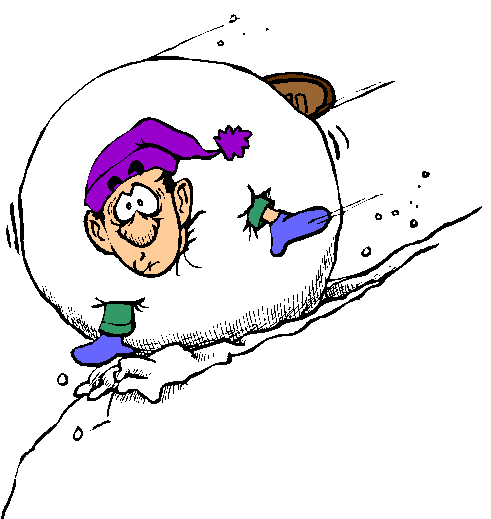
Being from Canada, I’m very familiar with snowballs. When I was young, my friends and I used to have snowball fights. This was a normal thing growing up in a cold country. Of course, usually the word “snowball” is a noun, but sometimes it can be used as a verb. That is what I’d like to write about today.

The verb, to “snowball” means for a situation to get bigger and bigger as time goes by. The reason the word “snowball” is used is because if we make a small snowball and roll it down a hill of snow, more snow will stick to it, and it will become much larger. Let me give you some examples of how to use “snowball” as a verb:

I made the mistake of offering to help a guy at my office with his report. Since then, the situation has completely snowballed. Now many of my co-workers are asking me for my help all the time!

I gave my son a Pokemon toy for his birthday, but now I regret doing that. It started off as one toy, but now the situation has totally snowballed. He has started collecting the toys, and now he wants a new one every week!

My friend started to write a short story about his family but soon after that, it really snowballed. He ended up writing a 400 page book about them.

The verb “snowball” is almost always used in the past tense and is usually used to describe negative situations that have gotten bigger and bigger over time. However it can be used to describe neutral situations as well, such as with the last example about the story becoming a book.

grammatical word: eat

whats eating you meditating on beach 2

As I’ve done in the past, today I would like to go over a common verb which has other meanings that many people don’t know about. Today, the verb is “eat”. Of course, everyone knows the main meaning of this word which is to consume food. However, we can also use it in three other ways:

1. for some kind of public vending machine or payphone to take money and then not work properly. For example:

That drink machine ate my dollar. Is there someone in the building who can get me my drink or my dollar back?

The payphone ate my coin and then disconnected me! I hate it when that happens!

2. for something to require a lot of money in order to maintain it. For example:

My car is costing me a lot of money. Between parking costs and gasoline, it’s eating a lot of my monthly paycheck.

Having kids is so expensive. After my wife and I had our son, the cost of taking care of him really ate through our savings.

3. for something to put someone in a bad mood. For example:

Edgar and Henry just left the room as soon as I said hello to them. What’s eating them?

I just heard Charlene tell her friend to shut up! What’s eating her?

If you look at the fourth example, you’ll see that I used “eat through”. When talking about something that is reducing our savings, we often add the word “through” to the verb “eat”.

In the final meaning of “eat” which is for something to put someone in a bad mood, we almost always use “eat” in the question form, What’s eating + someone. Please be careful about saying it directly to a person, as in “What’s eating you?”. This is very strong and could be offensive to the person you are talking to.

grammatical word: bound

nicolle-lavelle-it-was-bound-to-happen-typography-412x280

Today’s grammatical word is “bound” and, even though it is technically an adjective, it doesn’t function as a typical adjective, so I’ve decided to write about it as a grammatical word. It’s not typical as an adjective because it must always be followed by a verb and then the rest of the sentence.

It is used when we are making a prediction about something in the future, and we feel quite certain that it will be true. For example:

There are bound to be a lot of pretty girls at Kelly’s party because she’s a model.

A: I was invited to have dinner at a French restaurant tonight.

B: Then you’d better take a lot of money with you. It’s bound to be quite expensive.

I don’t want to go to the dance club on Saturday night. It’s bound to be really crowded.

A: Do you think Jake will come to the dinner tonight at the seafood restaurant.

B: He’s bound to come. He really loves seafood.

My favorite basketball team hasn’t lost a single game this season, so they’re bound to win again tonight.

As you can see, the word “bound” is always followed by the infinitive (to + base form of a verb). Often, the verb is “to be”, as in the first three examples, but we can also use other verbs, as in the last two examples.

grammatical word: fluke

index

Today, I would like to teach you a commonly used noun in the English language: “fluke”. It is used when we want to talk about being successful at something just from being lucky. For example:

When I was playing pool, I sank two balls in one shot, but it was just a fluke.

I made dinner for my friends last night, but I didn’t use a recipe. Usually when I do that, the food isn’t so good, but this time it turned out well. It was a total fluke.

A: How did Ryan manage to score the winning goal in the soccer game?

B: I think it was a fluke. He’s usually not such a good player.

So, as you can see, we use the word “fluke” with the verb “be” in the past tense – “was”. We often use it when talking about ourselves or other people who are not present, but it’s not polite to say directly to another person that the reason for their success was because it was a fluke. This word is usually used in casual conversations.

grammatical word: anyway

DoitAnyway

In a previous blog entry, I wrote about the difference between “anyway” and “by the way”, “speaking of” and “at any rate”, but there is another way that we use “anyway” in English. We can also use it when we want to say that someone does something despite a situation that should have prevented it. For example:

Billy is in trouble at school. His teacher told him not to throw anything in the classroom, but he did it anyway.

My friend told me that the food at Georgio’s isn’t good, but I want to go there anyway. The decor looks really interesting.

My son’s football won their game last night and everyone was so surprised. Their best players weren’t in the game, and they were playing against the best team in the league, but they won anyway!

We’re not supposed to eat at our desks in my office, but my boss lets us do it anyway.

So as you can see, we use the word “anyway” at the end of a sentence. Also, it’s important to note that this word can only be used in positive sentences; so we can say, “He did it anyway.”, but we CANNOT say, “He didn’t do it anyway.”

Next entries » · « Previous entries