Archive for idioms

idiom: to get/have cold feet

images

Today is Sunday, and that makes it idiom day! So today, I have an interesting expression for you: “cold feet”. We use this when we talk about a person who is really nervous about something that they are planning to do and is considering changing their mind about doing it. For example:

A: My wedding is tomorrow, and I’m really nervous about it!

B: I hope you’re not getting cold feet!

My brother agreed to make a speech at the conference but, at the last minute, he got cold feet and said he couldn’t do it.

A: You look really nervous about giving this presentation. If you have cold feet and don’t want to do it, I’ll understand.

B: No, it’s ok. I’m a little nervous, but I don’t have cold feet. I’ll do it.

I just heard that the Mark Jackson’s wedding was cancelled. I guess either Mark or his fiancee had cold feet and decided to call off the wedding.

This idiom is often used in situations to do with weddings and getting married, but it can be used in other situations as well. If we use it in the past tense, as in the second and fourth example sentences, it means that the person actually did actually cancel the plans because of being too nervous.

idiom: no strings attached

No-Strings-Attached-poster

I have another good idiom for you today: “no strings attached”. It is used when we want to say we will do something for another person without expecting to receive anything in return. For example:

My friend lent me his car last weekend with no strings attached. He’s such a nice guy!

A: I can help you move this weekend if you’d like me to.

B: Really? What do you want in return?

A: Nothing. No strings attached. I just want to do something nice for you.

_________________________________________________________________

A: The boss just gave me the day off tomorrow. No strings attached!

B: Really? That’s amazing! Why did he do that?

A: He said it was because I’ve been working really hard lately.

In the case of this expressions, the “strings” represent the conditions under which someone will do something for you. So, if there are “strings” in the first example, the friend might expect to borrow something else from the person in exchange for the use of their car. In the last example, the boss might expect the employee to work on another day when they aren’t supposed to work. However, in these cases, there are “no strings”, so nothing is expected.

idiom: to not hold one’s breath

dont_hold_your_breath_bumper_stickers-r86d8a8c659f24da6b0ec33d7cb51845e_v9wht_8byvr_512

The idiom for this week is “to not hold one’s breath”. It is used when we want to say that someone should not wait for something to happen when we know that it will never happen. For example:

The prime minister promised he would lower taxes this year, but I won’t hold my breath. Politicians always say things like that just to get elected.

A: Do you think the boss will give me a raise this year?

B: Don’t hold your breath! He never gives anyone a raise.

________________________________________________________________

A: Ned said he’d help me move this weekend.

B: If I were you, I wouldn’t hold my breath. He always says he’ll help people, but he never does it.

So, we often use this expression in the future tense (I won’t hold my breath.) or in the conditional tense (If I were you, I wouldn’t hold my breath.) However, the most common way of using it is in the imperative tense (Don’t hold your breath!) When it is used this way, it’s a little strong, but it’s not rude.

idiom: to not bat an eye

tumblr_mz7c1yD01n1skkqxbo1_500

I have another idiom for you this week. The expression is “to not bat an eye”. It is used when we want to talk about someone who is not shocked or surprised when most people would be shocked or surprised by a certain situation.

If someone bats their eyes, it basically means that they blink.  Usually if we receive some shocking news, it’s natural for us to blink our eyes when we hear the news. Therefore, if a person doesn’t blink or “bat an eye”, they are not shocked or surprised at all about something. For example:

When the salesman told Walter that the price would be $150,000, he didn’t  bat an eye. He just agreed to pay the money without hesitation. He must be really rich.

I told my girlfriend I wanted to go to Europe for six months alone, and she didn’t even bat an eye. I think maybe she doesn’t love me anymore.

My co-workers are really strange. The boss announced that everyone would have to take a 10% paycut and none of them batted an eye. I seem to be the only one who’s upset about that.

So, as you can see, this idiom is usually used when someone doesn’t react in a shocked or upset way to something another person tells them. Also, for emphasis, we can put the word “even” before “bat an eye”, as in the second example.

idiom: to have a lot on one’s plate

index

This week’s idiom is a commonly used expression in English: “to have a lot on one’s plate”. It is used to talk about a person who is very busy and has many things that they have to do. For example:

I’m afraid I don’t have time to write that report. I have a lot on my plate already. Maybe Lance can do it.

My sister has a lot on her plate these days. She’s got two kids, a full-time job and she does a lot of volunteer work. I don’t know how she does it all.

A: I can help you plan the office party if you want.

B: Don’t you have a lot on your plate already with the ABC project?

A: Well, I’m a little busy with that, but I still have time to help you.

This expression can be used in both work and free time situations, so it’s quite flexible.

idiom: to bite the bullet

images

I hope everyone is having a good weekend. Today, I’ve decided to go over the idiom: “to bite the bullet”. This expression is used to talk about something that we don’t want to do, but we can’t avoid doing it. Because we don’t want to do it, we delay doing it. When we finally do it, we use this expression, “to bite the bullet”. For example:

I know you don’t want to tell Harold that he’s fired, but you have to do it eventually. You should just bite the bullet and do it now.

I broke up with my girlfriend last night. I wasn’t happy in the relationship for a long time, but I had been putting it off. Finally, last night I just bit the bullet and did it.

A: I’m really nervous about asking my boss for a raise.

B: I know it’s hard, but just bite the bullet and ask him. The worst thing he can do is say no.

In the second example, the phrasal verb “put off” means to postpone doing something. Also, in the last example, the word “raise” means a salary increase. Therefore, the person is nervous about asking the boss for a salary increase and is delaying asking him for it.

idiom: to give someone a hard time

images

Today I think it’s time for another idiom, so I’d like to write about the expression “to give someone a hard time”.  This has the meaning of teasing another person. For example:

Every time I see Jennifer I like to give her a hard time about her job. She keeps saying she’s going to quit, but she never does. I love teasing her about it.

My younger brother just got his first girlfriend, so I love giving him a hard time about it.

Would you please stop giving Keith a hard time about spilling wine on his boss’ shirt? He’s very sensitive about it and doesn’t like it when you tease him.

When we give someone a hard time about something, it’s usually not meant to be unkind. The teasing is meant to be in good fun. However, some people don’t like it when we give them a hard time about something and can get upset.

idiom: to be a no brainer

index

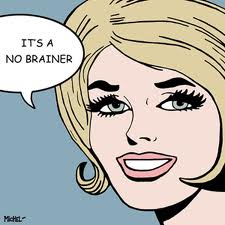
Recently one of my students asked me the meaning of the idiom: “to be a no brainer”. It is used when we want to say something is so easy that we don’t have to think about it and that the answer is obvious. For example:

A: Did you accept the job offer from ABC Company?

B: They offered me a high salary and really good benefits, so it was a no brainer. Of course, I accepted it.

_________________________________________________________________

A: Which car did you buy – the Toyota or the BMW?

B: It was a no brainer. The Toyota was much cheaper and I don’t have much money right now.

_________________________________________________________________

A: Who do you think is the best actor in the movies right now?

B: That’s a no brainer for me. It’s definitely Johnny Depp!

__________________________________________________________________

A: I don’t know what the capital of France is.

B: Oh come on! That’s a no brainer. It’s Paris.

This expression can be used when talking about decisions (as in the first two examples), opinions (as in the third example) or factual information (as in the fourth example).

idiom: to be (to take) a stab in the dark

STab-in-the-Dark

Hi there everyone. I apologize for not writing a blog entry for the last couple of days. I’m on vacation right now, so I don’t have the chance to write as often as I’d like to. Still, I’ll try to write the blog as much as I can.

Anyway, for today’s blog, I’d like to do another idiom: “a stab in the dark”. This can be used with either of the verbs “be” or “take”. It is used when we talk about make a complete guess about something that we don’t know the answer to at all. For example:

I don’t know what the capital of California is, but I’ll take a stab in the dark and say it’s Los Angeles.

A: How did you know the right answer to the teacher’s question? It was a really hard question.

B: I didn’t know it actually. It was a complete stab in the dark. I just got lucky.

___________________________________________________________________

A: I really don’t know what the answer is.

B: Well, just take a stab in the dark. It’s better than saying nothing.

We can use this idiom whether or not we get the answer correct. Sometimes we do, as in the second example, and sometimes we don’t, as in the first example. (The capital of California is Sacramento).

idiom: to talk shop

index

Today I have another useful idiom for you: “to talk shop”.  We use this idiom when two or more co-workers talk about their work together in their free time. For example:

When your co-worker comes over for dinner tonight, please don’t talk shop. It’s really boring for me.

Can we please not talk shop at the office party? I’d rather talk about other things.

I invited my friend from the office out for dinner last night, and all she did was talk shop. I wish she wouldn’t do that.

In our culture, “talking shop” has a rather negative feeling to it because most people want to talk about other things in their free time. What about you? How do you feel when your co-workers start talking shop when you’re not at work?

Next entries » · « Previous entries