Archive for idioms

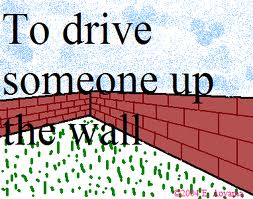
idioms: to drive someone (crazy), (nuts), (up the wall), (around the bend)

res

Today, I have four idioms for you that mean the same thing: “to drive someone crazy”, “to drive someone nuts”, “to drive someone up the wall”, and “to drive someone around the bend”. They are all used to talk about a person or a situation that really annoys us. For example:

My co-worker is always asking me to help her with her project! She’s really driving me crazy!

It drives me nuts when people cut in line when I’m at a store.

My roommate was driving me up the wall because he was always playing his music really loudly. Eventually, I asked him to move out.

My car is often breaking down when I’m driving. It’s driving me around the bend.

In all of these examples, the person feels extremely annoyed by the person or situation. The last three examples are a little more casual than the first one, “to drive someone crazy”. However, all the expressions are used in casual conversations.

idiom: to do the trick

that should do the trick

I hope everyone has been having a good week. It’s Friday now in Tokyo, so the weekend is almost here! Anyway, the idiom for today is “to do the trick”. It is used when we do an action that is enough to accomplish something. For example:

My computer wasn’t working properly. My friend suggested I reboot it, and that did the trick. It worked fine after that.

The soup I made isn’t spicy enough. I’ll put in a little bit of chili pepper, and that should do the trick.

This screwdriver is too small to do the trick. I need to get a bigger one.

My sister wanted to get Billy’s attention at school. I told her to wear a shorter skirt, and that really did the trick. Billy asked her out on a date.

This expression is often used when we’re trying to fix something as in the first two examples. However, it can also be used when trying to accomplish a personal goal as in the last example.

idioms: search me, beats me, beats the hell out of me

beats-me-68099941886

Today I have three idioms that mean the same thing: “search me”, “beats me” and “beats the hell out of me”. They all mean, “I don’t know”. For example:

A: What is the capital of Finland?

B: Search me. Why don’t you look it up on the Internet?

________________________________________________________________

A: Do you know where the Carlton Bookstore is?

B: Beats me. I’m just a tourist in this city.

_______________________________________________________________

A: Where did Trevor go?

B: Beats the hell out of me. He never tells me anything.

All three expressions are used in casual situations. However, the expression “beats me” sounds a little more casual than “search me”, and “beats the hell out of me” is the most casual. It would usually only be used with friends. The word “hell” makes it a bit rude, but it’s not extremely offensive.

idiom: to be tied up

lucy-tied-up1

I have another idiom today which is often used in business situations: “to be tied up”. This expression is used when people want to say that they are busy doing other things so that they can’t do something else. For example:

I’m afraid I can’t meet with you on Monday at 3:00. I’ll be tied up all Monday afternoon.

I’m going to be tied up with meetings all day on Thursday. Let’s try to meet on Friday instead.

I’m sorry, but Mr. Tanaka is tied up in a meeting right now. Would you like to leave a message for him?

So, as I mentioned already, this expression is used in business situations. If you want to talk about a free time situation, you can say, “I’m busy.” or “I have plans”.

idiom: to take a load off (one’s feet)

IMG_4098

It’s the beginning of Golden Week in Japan. This is a famous holiday season in Japan which allows the very hard-working people of this country to take a well-deserved break for about five days. So, in the spirit of holiday, I’d like to write about an idiom which has to do with relaxation: “to take a load off”. We can also say “to take a load off one’s feet”. This idiom means for someone to sit down and relax. Let me give you some examples:

You’ve been working so hard all day. Please sit down and take a load off your feet. I’ll get you a drink.

I’m so tired right now. I need to find a place where I can sit down and take a load off.

Please come in and take a load off your feet. I’ll be with you just as soon as I’ve finished cooking dinner.

So, with this expression, the “load” is a person’s own body weight. When we sit down, we no longer have to support the weight of our own bodies; therefore we take that load (weight) off our feet. This expression is only used in casual situations.

idiom: to be a different story

vn

The idiom I’d like to write about today is “to be a different story”. It is used to talk about when one situation is completely different from another situation. For example:

My father is so unfair. He never lets me borrow the car, but if my brother needs it, then that’s a different story. He lets my brother do anything he wants.

In many countries in the world people get angry if someone is late, but in Latin countries, it’s a different story. My friend from Brazil tells me people there don’t mind if someone is late.

Before the recession, I didn’t worry about money, but now it’s a different story. Now I’m very concerned about saving money.

We could substitute the word “situation” for the word “story” and people would understand, but it wouldn’t sound natural; “to be a different story” is a very natural and useful expression in English. I hope you’ll be able to use it now.   🙂

idiom: to miss the boat

vb

Today’s idiom is “to miss the boat”. It is used to talk about a time when someone has missed a good opportunity. For example:

My friend said I should invest in that stock, but I didn’t. Then, it went up to ten times its original value. I really missed the boat on that one.

You should apply for this job. It’s a great opportunity! You don’t want to miss the boat, do you?

My brother could have made a lot of money if he had invested in that company right away. Unfortunately, he waited too long and missed the boat.

As you can see, this idiom is usually used in business situations, especially about investing in something and having the opportunity to make money.

idiom: to bite off more than one can chew

gh

I think it’s time for another idiom. Today’s expression is “to bite off more than one can chew”. It is used when someone has chosen to do something that is too difficult for them to do, or when they have chosen to do too many things and can’t handle doing all of them. For example:

My sister has signed up for an advanced Spanish course, but she can’t speak Spanish so well. I think she’s bitten off more than she can chew.

Last month I volunteered to work on another project. I’ve totally bitten off more than I can chew.

A: You want to do a double major at university? Don’t you think you might be biting off more than you can chew?

B: No, I’m sure I can handle it.

This is quite a common and useful expression. I hope you find it interesting.

idiom: to get/have a frog in one’s throat

frog_in_throat3

The first thing I’d like to tell you today is that I have added a little more information to my previous blog entry about the difference about “each” and “every” that was published on March 24th. I hope that the new information and examples will make this clear to everyone.

As for today, I want to do another idiom: to have a frog in one’s throat. This is used when we talk about having some phlegm in our throats which makes it difficult to speak clearly. This doesn’t mean the person is sick though. If you are sick and your throat hurts, then you should say, “I have a sore throat.” Let me give you some examples of how to use today’s idiom:

I often get a frog in my throat after I eat, so I usually drink water to get rid of it.

I’d better not eat anything before my presentation. I don’t want to get a frog in my throat.

A: Do you have a cold? Your voice sounds strange.

B: No, I’m not sick. I just have a frog in my throat, that’s all.

The difference between “get” and “have” when talking about health conditions is that first we “get” a condition, and then we “have” the condition. For example:

A: I have a bad cold now.

B: Oh really? When did you get it?

A: I got it the day before yesterday.

I’m not exactly sure why we say we have a “frog” in our throats, but I suppose it’s maybe because we might sound like a frog when we talk with a lot of phlegm in our throats. That’s my guess anyway. Anyway, I hope you don’t often get a frog in your throat. I often do, and it’s very annoying.

idioms: to beat someone to the punch / to beat someone to it

2012-08-22_13-18-04_727_edit0

Today’s idiom is “to beat someone to the punch”.  Another version of it is “to beat someone to it”. These are used when someone does something before another person gets the chance to do it. For example:

I was going to order a pizza, but my girlfriend beat me to the punch. It should be here soon.

I was planning to write a book about a boy wizard, but J.K. Rowling beat me to the punch.

I was going to eat the last piece of pie, but my sister beat me to it.

A: Hey, I wanted to sit in that chair!

B: Sorry, but I beat you to it. You’ll have to be faster next time!

There is almost no difference between these two idioms, but we usually say “to beat someone to it” with smaller situations such as being the first person to get something such as a chair or a piece of pie. Therefore, in these situations when we say someone beat us to “it”, the “it” refers to a physical object rather than an action.

In the idiom “to beat someone to the punch”, the “punch” refers to an action such as ordering something or writing a book because the word “punch” is an action word. (It means to hit someone or something).

Next entries » · « Previous entries