Archive for idioms

idioms: to be over someone’s head / to go over someone’s head

3qelh4

There are two idioms today which are very closely related: “to be over someone’s head” and “to go over someone’s head”. They are used to talk about something which we don’t understand because it’s too complex for us. For example:

My friend likes to study philosophy. He understands it, but it’s totally over my head.

I tried to study physics in university, but it was all over my head.

I tried to tell a joke to my friend, but she doesn’t speak English well so it went over her head.

I don’t know much about computers, so I’m going to take a course about that. I hope what the teacher says doesn’t go over my head.

These two expressions are almost exactly the same except that we use “to go over someone’s head” with something which we experience once such as a joke or a lecture. We use “to be over someone’s head” with a general subject such as philosophy, physics, chemistry, etc.

idiom: off the top of one’s head

zo

Today, I have another idiom for you: off the top of one’s head. This is used when we say something without having the chance to really think about it before. It is usually used when talking about suggestions, ideas or when answering a question. For example:

A: Do you know of any good French restaurants in this area?

B: I can’t think of any off the top of my head, but there might be some.

________________________________________________________________

A: I don’t know of any good people in our company for the position of HR manager.

B: Really? Off the top of my head I can think of at least five people, and I’m sure there must be a lot more.

________________________________________________________________

A: What color do you think we should paint the living room?

B: Off the top of my head I would say green, but maybe we should think about it a little more.

________________________________________________________________

A: Do you know what  the capital of Spain is?

B: Off the top of my head I’d say Madrid, but it could be Barcelona. You’d better look it up on the Internet.

As you can see, this idiom is usually used as a response to someone’s question. Also, we almost always use it when talking about ourselves so we say “off the top of my head”, rather than “your head”, “his head”, etc.

idiom: to ring a bell

zy

Today I have an idiom for you which is not related to a part of our bodies: to ring a bell. We use this to talk about something which we can remember a little but not clearly. For example:

A: Do you remember a guy named Martin Fisher?

B: The name rings a bell, but I don’t remember him very well.

________________________________________________________________

A: I watched an old movie last night called “Goodbye Mr. Chips”. Have you seen it?

B: Well, it rings a bell, but I’m not sure if I’ve seen it or not.

We can also use this expression in the negative: to not ring a bell. In this case, it means that we don’t remember ever hearing about something or someone in the past. For example:

A: Have you ever heard of “Blue Monday”? They were a rock band in the sixties.

B: Sorry, that doesn’t ring a bell.

________________________________________________________________

A: I ran into our old classmate, Patty Shelton, at the shopping mall today.

B: Patty Shelton? Are you sure I’ve met her? The name doesn’t ring a bell.

This is a very commonly used idiom among English speakers. I hope you find it useful.

idiom: to have a big mouth

big mouth

Today, I’d like to write about another idiom: to have a big mouth. This means for a person to be unable to keep a secret. We usually use this expression when talking about other people, but we don’t usually say this about ourselves. If you say it directly to another person, it’s very strong and not so polite. For example:

My sister told everyone about my promotion before I could do it! She has such a big mouth!

Don’t tell Martin about Jane’s surprise party! He’s got a really big mouth, and he’ll probably tell her.

I can’t believe you told my parents that we were drinking beer last night! You have such a big mouth!

As you can see in the examples, we often emphasize this expression with “such a” or “really”. If we simply say something like, “He has a big mouth”,  it sounds rather weak and a little unnatural.

idiom: to bite one’s tongue

zs

Yes, today we have yet another idiom related to our bodies. This one: to bite one’s tongue. It is used when someone wants to say something but knows it’s not a good idea, so they have to stop themselves from saying it. For example:

Jeff asked me what I thought of his new jacket. It’s really ugly, but I couldn’t say that to him, so I just bit my tongue and told him it was nice.

A: At the meeting, my boss took credit for my idea.

B: Really? That’s terrible. Did you say anything?

A: No, I just bit my tongue. I don’t want my boss to get angry at me.

We can also use this idiom in the imperative. This means that you use the verb as the first word of a sentence, without using the word “you”, in order to tell someone what to do. This is used when giving orders, instructions or directions. For example:

Come here please.

Turn left at the next corner.

Press the red button.

When we use “to bite one’s tongue” in the imperative, it means we are telling someone that their statement is unwelcome from our point of view. For example:

A: I heard it’s going to rain tomorrow.

B: Bite your tongue! I’m supposed to go on a picnic tomorrow.

________________________________________________________________

A: I really don’t think the Allstars will win the championship.

B: Bite your tongue! They’re my favorite team! I really want them to win!

idiom: to put one’s foot in one’s mouth

foot in mouth

I have another body idiom for you today. As you can tell by now, we have many idioms in English related to our body parts. This time the expression is “to put one’s foot in one’s mouth”. When we are using it in conversation though, we don’t say “one”; instead we replace that with “my”, “your”, “his”, or “her”. We generally don’t use this expression with plural forms such as “our” or “their”.

Anyway, people use this idiom to mean they have said something stupid to another person and insulted them by accident. It’s important to note that it’s always by accident and never on purpose. If we insult someone intentionally, we cannot use this expression. For example:

I was talking to Jim about that woman in the corner and I said she was ugly. I didn’t know she was his wife! God, I really put my foot in my mouth!

A: Have you ever put your foot in your mouth?

B: Yes, one time I met a woman at a party and said that I thought the party was really boring. It turned out she was the hostess! I really put my foot in my mouth! I was so embarrassed!

idiom: to be on the tip of one’s tongue

tip_of_the_tongue

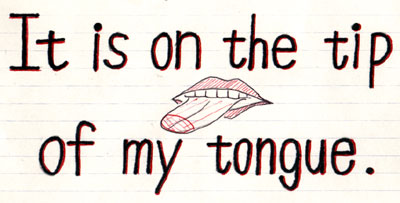
Today, I have another body idiom for you: to be on the tip of one’s tongue. This is used in situations where you have forgotten some piece of information, and you can almost remember but not quite. The information is usually quite simple such as someone’s name, the title of a movie or even just a word. For example:

I can’t remember the name of that movie, but it’s on the tip of my tongue.

What’s your brother’s name again? Wait, don’t tell me! It’s on the tip of my tongue.

What’s the word for “chair” in Japanese? Oh, it’s on the tip of my tongue! I hate it when this happens!

As you can see, we use this idiom when we ourselves forget some information, but it’s unnatural to use it about other people. Therefore, we DON’T say, “It’s on the tip of your tongue” or “It’s on the tip of her tongue”, etc. Also, we don’t use it when we forget some information which is more detailed and complex.

idiom: to jump down someone’s throat

yu

Today, I think it’s time for another idiom, and I’ve chosen another one which is a body idiom: to jump down someone’s throat. This means for someone to get very angry at another person and then yell at them. For example:

I was just five minutes late for work, but my boss just jumped down my throat when I got there.

My wife jumped down my throat  when I got home last night because I forgot our anniversary.

In both of these cases, the boss and the wife were shouting at the person. If someone gets angry but doesn’t shout, we usually don’t use this idiom.

Also, we don’t usually say, “I jumped down my husband’s throat” or things like that. It’s most natural to use this idiom when describing a situation when someone else yells at us, but not when we yell at other people.

idiom: to cost an arm and a leg

4579L_2

Today, I’d like to go back to idioms. We have many idioms about body parts. Previously, I taught “to play it by ear” and today we have another idiom about our bodies: “to cost an arm and a leg”. This means that something costs a lot of money, in other words, it’s VERY expensive.

You can imagine that if you want to buy something and the store clerk says, “Ok, I’ll trade you one of your arms and one of your legs for this item.” Now, I don’t know about you, but my arms and legs are VERY valuable to me, and therefore would be worth a LOT of money. So that’s why this idiom means that something is very expensive. For example:

The tickets to the concert cost an arm and a leg, but they were worth the price. We had such a good time!

Renting an apartment downtown will cost you an arm and a leg. Why don’t you stay in the suburbs?

Bob just bought a new house. I hear it cost him an arm and a leg.

Please remember that when you use idioms, you can’t change any of the words. Therefore, if you say, “It cost me arm and leg.” or “It cost me an arm and leg.” or “It cost me arm and a leg.”, it will sound strange. So please don’t forget to say “a”, “an” and “the” when you’re memorizing  sentences. Articles ARE important. 🙂

idiom: to play it by ear

For today’s blog entry, I’d like to talk about the idiom “to play it by ear”. This means that someone will not make a decision about an event until they are in the moment. I think the idiom might possibly come from music. I always think of the scene in Amadeus when Mozart is composing a song on the spot for the King. He was able to simply create the music in the moment without having to practice it before. So he was playing the music and creating it by listening to it with his ears so literally he was playing it by ear. I don’t know if this is the true origin but that’s my guess.

Anyway, nowadays the idiom means to not make plans or come to a decision before a certain event is taking place. For example:

A: What are you going to do this weekend?

B: I don’t know yet. I’m just going to play it by ear.

________________________________________________________________

A: How long should we stay at the party?

B: Well, let’s play it by ear.

This idiom is often used as a response to someone’s question about their plans. In the first example, the person hasn’t made plans but will decide what to do when the weekend finally comes. In the second example, the person doesn’t know if the party will be good or bad. If it’s good, they’ll stay for a long time but if it’s bad, they’ll leave early. They can’t make that decision until they arrive at the party.

It can also mean that someone will improvise what they will do in a situation where they haven’t prepared. For example:

I didn’t plan my speech for my cousin’s wedding, so I’ll have to play it by ear.

So this is the idiom for today. It’s a very common expression in English so I hope you find it useful.

Next entries » · « Previous entries