Archive for phrasal verbs

separable phrasal verb: set up

Set_Up

This week’s phrasal verb is “set up”, and it has five different meanings.

1. to assemble or prepare something for use. For example:

Can you help me set up the computer? I don’t know how to do it.

My computer needs to be set up. Can you help me? (passive voice)

We have to set up everything for the party by 5:00.

Everything has to be set up for the party by 5:00. (passive voice)

2. to frame someone for a crime. For example:

I swear I didn’t kill those people! Someone else did it and then set me up!

In the movie, the main character was set up for some murders. (passive voice)

3. to establish something (often a business). For example:

I want to set up my own business, but I know it’s going to be difficult.

The billionaire set up a charity in order to help handicapped people.

The charity was set up by a billionaire in order to help handicapped people. (passive voice)

4. to establish someone in business. For example:

My uncle set me up in the restaurant business. I couldn’t have done it without his financial support.

I was set up in the restaurant business by my uncle. (passive voice)

5. to arrange a blind date for someone. For example:

Can you set me up with your cousin? I think she’s really pretty.

My friend wants me to set him up with my cousin.

The second meaning for this phrasal verb (to frame someone for a crime) is the type of language that we only hear in a movie or TV show. We can also use it when talking about a movie or TV show, but obviously most of use wouldn’t use it in our everyday lives. Also, please be careful to use the preposition “with” when using the final meaning (to arrange a blind date for someone). If you don’t know, a “blind date” is a date with someone that you’ve never met before, and which is usually arranged by another person.

inseparable phrasal verb: feel up to

Sick-person

Today I have a phrasal verb for you that is quite simple but very useful and commonly used: “feel up to”. It is used when we talk about having enough energy or being healthy enough to do something. For example:

I want to go to the party with you, but I have a cold. I’m just not feeling up to it. Sorry.

Are you feeling up to cooking tonight? If you’re too tired, we can order a pizza.

A: If you’re not feeling well, we don’t have to go out for dinner.

B: It’s ok. I had a headache before but it’s gone. I think I’m feeling up to going out now.

Do we have to invite Dan to our party? He always talks shop, and I’m really not feeling up to hearing him complain about his job.

If you feel up to it, I’d like you to help me cook dinner.

With this expression, it’s much more common to use it in negative sentences or in questions. It’s a little unusual to say “I’m feeling up to going out tonight.”, but sometimes we can add “I think” to the beginning of the sentence and that makes it sound more natural (as in the third example sentence). So, instead of saying “I’m up to going out tonight”, we would probably say something like, “I want to go out tonight.” or “I feel like going out tonight.”

In the fourth example, I use the idiom “talk shop”. If you don’t know this expression, you can check my blog from June 2, 2010.

inseparable phrasal verb: live up to

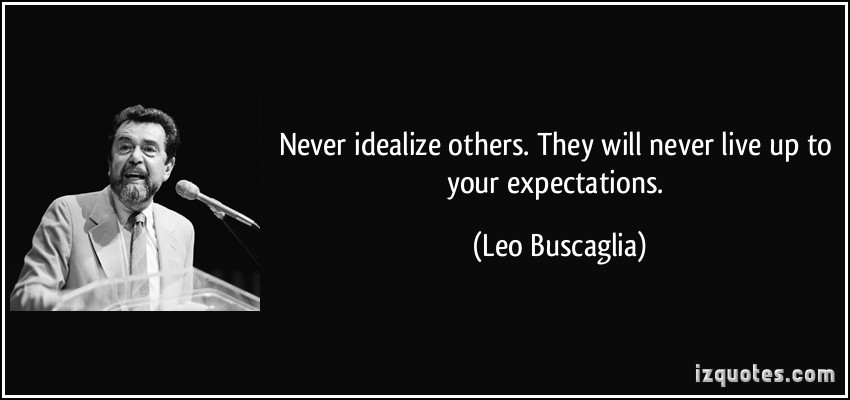
quote-never-idealize-others-they-will-never-live-up-to-your-expectations-leo-buscaglia-28273

The phrasal verb for this week is “live up to”. It’s an example of a three word phrasal verb. Another example of this that I’ve written about in the past is “come up with”. Almost all three word phrasal verbs are inseparable which means that the object, whether it’s a noun or a pronoun, will come after the third word (a preposition).

The phrasal verb “live up to” is used when we talk about a person who fulfills someone else’s expectations or follows their example. For example:

My father has such high standards for success. I could never live up to his expectations.

My father’s expectations for success can never be lived up to. (passive voice)

My mother is an amazing woman. I’ve tried hard all my life to live up to her example.

I really admire my teacher. I hope I’ve been able to live up to her expectations.

So, when we use this expression, the person whose expectations are trying to be lived up to must be someone in a high position in comparison with the speaker. Often it’s someone’s mother or father, but it’s possible to be another person as well. When using this expression, we usually DON’T say something like , “I lived up to my father’s expectations.” Instead, it’s more natural to use it in the negative. For example:

I didn’t live up to my father’s expectations.

We can also use it with the word “try”. For example:

I tried to live up to my father’s expectations, but I couldn’t.

I’m trying to live up to my mother’s example.

So, that’s the phrasal verb for this week. I hope everyone has a great weekend!

inseparable phrasal verb: go by

images

The phrasal verb for this week is “go by”. It is inseparable which means that the object (either a noun or a pronoun) will come after the word “by”.  It has three meanings in English.

1. to use as a name (usually a shorter form of someone’s real name). For example:

My name is Michael, but usually I just go by Mike.

My friend Takahiro goes by the name Taka with his foreign friends.

2. for someone to believe something that someone else tells them (often used in the negative). For example:

I never go by what a salesperson in a store tells me. They’ll say anything to make a sale.

If I were you, I wouldn’t go by anything Ian tells you. He tells a lot of lies.

3. to let a chance pass. For example:

My father let his chance for success go by, and now he’s very unhappy.

I have a great opportunity to make some money, and I can’t let it go by.

In the case of the last definition, “go by” is intransitive which means that there is no object in the sentence.

intransitive phrasal verb: chill out

index

The phrasal verb “chill out” is a casual expression that means to relax. It’s generally neutral in tone, but it can sound a bit negative sometimes. For example:

A: What are you doing?

B: Nothing. I’m just chilling out in my apartment.

I don’t want to go out tonight. I’m tired, so I just want to chill out at home.

Stop worrying about the new job. It’ll be fine. You really need to learn to chill out.

A: I don’t want to eat Chinese food tonight!

B: Ok. Just chill out! We can order something else.

So, when using “chill out” to talk about ourselves, as in the first two examples, the tone is neutral. However, when using it directly to another person, as in the last two examples, it’s quite strong and not very polite. Therefore, please be careful when using this expression. If you use it directly to someone else, they could get angry with you.

separable phrasal verb: kick out

index

The phrasal verb for today is “kick out”, and it is used when we talk about a person being told to leave a place by someone else. For example:

The bartender at that bar kicked out my friend because he insulted him.

My friend was kicked out of that bar last night because he insulted the bartender. (passive voice)

My landlord is kicking me out of my apartment because I can’t pay the rent.

I’m being kicked out of my apartment because I can’t pay the rent. (passive voice)

My wife found out that I was having an affair, so she kicked me out.

I was kicked out by my wife because she found out I was having an affair. (passive voice)

So, a person can be kicked out of a public place (as in the example with the bartender) or a person can be kicked out of a private home (as in the examples with the landlord and the wife). When it’s a public place, the person might be allowed to come back at another time but, when it’s a private home, the person is usually never allowed to come back. So, in the example with the wife, the sentence has the sense that she will probably divorce him.

separable phrasal verb: burn up

index

Today’s phrasal verb “burn up” has two basic meanings:

1. for something to make a person very angry. For example:

My boss is so arrogant and rude. He really burns me up!

It really burns me up when I hear about corrupt politicians taking bribes!

2. for someone to destroy something on purpose by burning it (usually something made of paper or cloth). For example:

After I broke up with my girlfriend, I didn’t want to keep her letters to me, so I burned them up.

The corrupt politician burned up all his financial records because he didn’t want the police to find out about his illegal activities.

There is another meaning of “burn up” which is very closely related to the second meaning. It is used when we want to say something was destroyed in a fire by accident. In this case, the phrasal verb is intransitive. For example:

I’m upset because all of my old photos burned up in the fire.

inseparable phrasal verb: hit on

images

Today I have another inseparable phrasal verb for you. Once again this means that the two words CANNOT be separated by a noun or a pronoun. The noun or pronoun must come after the second word. Today’s phrasal verb is “hit on”.  It has two meanings:

1. to talk to someone with the intention of starting a sexual or romantic relationship with them. For example:

This really strange guy was hitting on me at the bar last night, so I don’t want to go back there for a while.

I was hit on by a really strange guy last night. (passive voice)

A: Excuse me. I just wanted to say you’re the most beautiful girl in the room. Are you a movie star?

B: Are you hitting on me? I’m sorry, but I’ve already got a boyfriend.

2. to think of a good idea or a good explanation for something. For example:

I think you’ve really hit on something with your idea for that new restaurant. I”m sure it’ll be very successful.

A: I think the main reason for crime is poverty.

B: Yes, you’ve hit on it exactly.

We often use the word “something” when talking about thinking of a good idea. Therefore, instead of saying, “You’ve hit on a good idea.”, it’s more natural to say, “You’ve hit on something.”

intransitive phrasal verb: come around

230318616_640

I have another phrasal verb for you today but, don’t worry, it doesn’t have as many meanings as “pick up”. Today’s expression is “come around”, and it only has three meanings.

1. for someone to change their thinking and start to support someone. For example:

At first, my mother wouldn’t support my decision to start my own company, but eventually she came around.

A: Dad really hates my fiancee! He says he won’t come to our wedding.

B: Don’t worry! Your father can be stubborn sometimes, but he’ll come around.

2. for someone to gain consciousness again. For example:

My sister fainted, but she came around after we sprinkled water on her face.

Oscar fainted! Everybody please stand back! He’s coming around now!

3. to visit someone’s home. For example:

We really enjoy talking to you, so please come around whenever you have time.

Mom, my friend Rob might come around this weekend. Is that ok with you?

So all of these examples are intransitive which means that there is no object in the sentence.

intransitive phrasal verb: pick up (part three)

businesssuccess

Today is the final entry for the phrasal verb “pick up”. All the definitions today are intransitive which means there is no object in the sentence. So here are the final three meanings:

13. for some form of entertainment to become more interesting or exciting. For example:

The action movie was quite slow at the beginning, but it really picked up in the middle.

The song is very slow at first, but the tempo picks up a lot after the first verse.

14. for business to improve after going down. For example:

Business really picked up after the summer because people were no longer on summer vacation.

Sales were down for the first three months of this year, but they’re starting to pick up now.

15. for someone to leave suddenly (used with “and left”). For example:

A: Where’s Ralph?

B: I don’t know. He was here, but then he just picked up and left. I don’t know where he went.

As I mentioned in part one of this series, the phrasal verb “pick up” has the most number of meanings. Many phrasal verbs have more than one meaning, but “pick up” is an unusual case. Most other phrasal verbs with many meanings usually only have about five or six definitions maximum. However, because these expressions have more than one meaning, it’s important to study the full sentences so you can understand how to use them, and in what situations they can be used.

Next entries » · « Previous entries