grammatical word: contend

CONTEND_GIF_copy.gif (684×453)

Today’s grammatical word is the verb “contend”. It has three uses in English. First, we use it when we want to talk about a difficult situation or person that we have to tolerate. For example:

I don’t like my new boss. He’s not very nice to me, and I have to contend with his constant criticisms.

Nobody likes Mr. Carson, but he’s a very important client. You’ll just have to learn to contend with him.

A: Sales are down right now at my company because of the bad economy, so I’m not making so much money right now.

B: Well, that happens sometimes. You just have to contend with that situation until things get better.

We can also use it to talk about a competition between two groups or people. For example:

Dan Wheaton and George Bartley are contending for the title of boxing heavyweight champion of the world. Personally, I think Wheaton will win.

I’m contending with two of my co-workers for the job of department manager. I hope I get the promotion.

Tokyo was contending with three other cities for the 2016 summer Olympics, but they lost out to Rio de Janeiro.

Finally, we can use “contend” when we want to talk about expressing an opinion about something that other people don’t agree with. For example:

I know the other people in my class disagree with me, but I contend that George Eliot was a better writer than Charles Dickens.

My wife contends that learning Chinese characters isn’t so difficult, but I don’t agree. It’s so hard for me.

Nobody believes Trevor when he said he saw a UFO, but he still contends that he actually saw one.

So, as you can see from my examples, the word “contend” is followed by different words depending on the meaning. With the first meaning, it is followed by “with”. With the second meaning, it is followed by “for”, and for the last meaning, it is followed by “that”.

the difference between words: up to and depends on

pointing_finger.jpg (296×304)

A while ago, a friend of mine asked me about the difference between “up to” and “depends on”, so that’s what I’ll write about today.

In English, “up to” is used when we want to say that a certain decision can be made by a certain person. For example:

I don’t care which movie we watch tonight. It’s up to you.

My boss left it up to me to choose the restaurant for our office party.

I’m sorry, but it’s not up to me to make this decision. I’ll have to check with my boss.

We can also use “up to” when we want to say that a certain thing is someone’s responsibility. For example:

It’s up to the department manager to make sure this project is finished by the deadline.

It was up to you to let everyone know about the schedule change, but you forgot! I’m very angry at you right now!

The accident caused a lot of damage to the environment. Now it’s up to the government to do something about it.

On the other hand, we use “depends on” when we want to talk about when a certain situation can be changed by another situation which it has a direct relationship with. For example:

I don’t know if we’ll go hiking tomorrow or not. It depends on the weather.

A: Will we have an office party this year?

B: I’m not sure. It depends on how many people accept the invitation.

I received two job offers. I don’t know which one I’m going to accept yet though. It depends on how much the salary is at each company.

So, with these last three examples, the decision that has to be made (to go hiking or not, to have an office party or not, which job offer to accept) has a direct relationship with the situation (if the weather is good, if many people accept the invitation, how much money is offered as a salary). After “depends on” we can put either a noun (as in the first example) or a clause which starts with a wh question word (as in the last two examples).

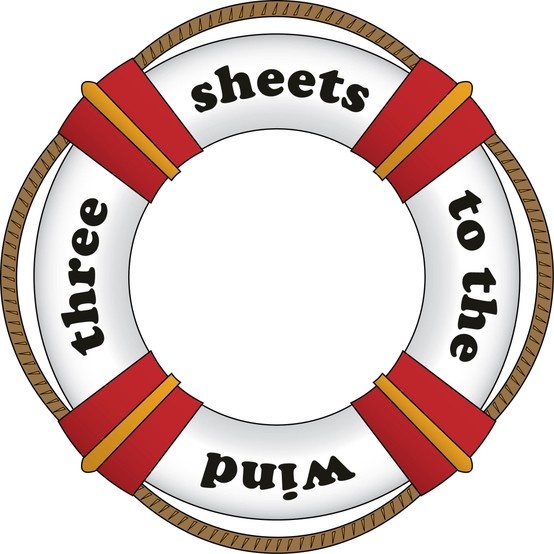
idiom: to be three sheets to the wind

threesheetsrva_1348076574_600

If you or your friends tend to drink a lot, today’s idiom will be very useful for you. It’s to be “three sheets to the wind”, and it is used to talk about a person who is very drunk. For example:

Debbie has been drinking martinis all night, and now she’s three sheets to the wind.

Don’t go near Tom now. At the moment, he’s three sheets to the wind, and he looks like he might be sick.

A: Where are Jack and Ben?

B: They’re down at the bar. I’m sure they’re already three sheets to the wind by now.

Did you see Luke at the party last night? He was already three sheets to the wind when he arrived!

I had to look up the reason why “three sheets to the wind” means very drunk. Apparently, it’s a sailing term; if a boat had three sails (or sheets) up, the wind would cause the boat to roll and rock. This is similar to the way a person moves when they are very drunk.

We usually use this expression only to describe people who are very drunk at the present moment or in the past.

separable phrasal verb: bowl over

BQcDAAAAAwoDanBnAAAABC5vdXQKFjdvNk1KaEJNNEJHLWJUWnQxQWRNSHcAAAACaWQKAXgAAAAEc2l6ZQ

Today, I would like to write about the phrasal verb “bowl over”.  We use it when we want to talk about something or someone which really impresses us. For example:

I had no idea Sarah was such a good singer. She really bowled me over when we went to karaoke last night!

The special effects in that movie absolutely bowled me over! I want to go see it again.

The people in Korea are so nice. My friend and I went there last year, and they bowled us over with their hospitality!

I was bowled over by the food in that restaurant! We have to go there for dinner sometime! (passive voice)

So, we always say bowl someone over; a person and not a thing has to be put in the middle position between “bowl” and “over”. The thing or person which impresses us is always the subject of the sentence.

grammatical expression: you gotta love…

https://i0.wp.com/www.bobthefish.com/categoryImages/limited_edition_you_gotta_love_bob.jpg

I have a very casual but useful expression for you today. It’s “you gotta love”. It is used when we want to talk about something that we like and think that everyone must feel the same way about it for a certain reason. Then, we usually express that reason in the next sentence. For example:

You gotta love this restaurant. The food is good, the prices are low and they give you a lot of food.

You gotta love this city in the summertime. The girls are pretty and they all wear short skirts.

You gotta love smart phones. You can do so many things with them.

You gotta love Jim. He’s really smart and funny.

The word “gotta” is a very casual way to say “have got to” which is another way to say “have to”. In this expression though, it doesn’t mean that everyone must like this person or thing; we are simply saying that this thing or person is really great.

adjectives: rational/irrational

https://i0.wp.com/www.loveamourlove.com/Images/My_own_relationship_articles_images/he_looks_so_rational_in_love_en_amour.gif

Today I want to write about two adjectives which are the opposite of each other: “rational” and “irrational”. We use the word “rational” to talk about an action, a decision or a general way of thinking which is based on calm logic. We use the word “irrational” to talk about an action, a decision or a general way of thinking which is based on fear or pure emotion. For example:

This is a very difficult decision for us, so we need to be as rational as possible when making it.

My dog was suffering so I had her put to sleep. It was very hard, but I think it was the rational thing to do.

A: I’ve decided to quit my job.

B: Please be rational about this. You’ll never find another job that pays you as much as this one does!

Many people lost money on this stock because they became irrational and sold all their stock as soon as price started going down. However, the price soon went up again.

My husband can be very jealous and irrational. If he sees me talking to another man, he thinks that I’m flirting with him.

My friend was very sick last year and made some very irrational decisions because he thought he was going to die.

In my second example, I talk about putting a dog to sleep. This is a more gentle way to talk about having a veterinarian kill an animal because it is suffering pain. It is done in order to be kind to the animal. Also, in my fifth example, I talk about “flirting”. The verb “flirt” means to talk to another person in a sexual way because you’re interested in them sexually or romantically.

grammatical word: head

https://i0.wp.com/www.fatcat.com.au/admin/uploads/226_nota_car_driving2.jpg

It’s time for another grammatical word, and today I want to write about the verb “head”. Most people know the word “head” as a noun, but we can also use it as a verb. We can use it as a verb in three ways:

1. to go somewhere. For example:

I’m going to head home now. Is there anything you need from me before I leave?

If you want to go to Brentwood, take the train heading west, not east.

A: Where are you headed?

B: I’m headed to Chicago. Can I give you a ride?

2. to be the leader of something. For example:

I’ve chosen James to head the project, so you will all report to him.

There was a revolution in that country, so we don’t yet know who will head the next government.

One day, I would like to head my own company. It’s always been my dream.

3. to be in the lead position of something. For example:

My wife and I haven’t decided on a place to go on our vacation yet, but Spain is heading the list right now.

We’re in the middle of an election now. All the votes haven’t been counted yet, but so far, David Miller is heading the race.

The doctors aren’t sure what’s wrong with me, but they said that cancer is heading the list of possibilities.

With the first meaning of “head”, we can use it about a person or with a kind of public transportation like a train. With the third meaning, we often use “head” to talk about what’s at the top of a list.

the difference between words: have to and need to

https://i0.wp.com/www.thetechherald.com/media/images/200819/PostIt_16.jpg

The entry for today is a very subtle one: it’s the difference between “have to” and “need to”. There is a slight difference in nuance between them. We say “have to” when we want to talk about obligations – things we have no choice about doing. However, we say “need to” when we want to talk about things that are necessary to do in order to achieve a certain goal. For example:

I have to be at work by 9:00 a.m. every morning.

I have to help my friend move tomorrow, so I can’t have lunch with you.

You have to turn off the lights if you’re the last person to leave the office.

I want to go to Vietnam for my vacation, so I need to get a visa.

If you want to get a promotion, you need to work very hard.

If your daughter wants to be a model, she needs to lose some weight.

In the case of the second example, the person uses “have to”, even though they have a choice about helping the friend move. In these cases, when we agree to do something, we feel an obligation to do it, and so we use “have to” in these cases.

In the last three examples for “need to”, the person does the thing (get a visa, work very hard, lose some weight) in order to achieve the goal (go to Vietnam, get a promotion, be a model).

Sometimes, “have to” and “need to” can be exchanged freely in a sentence and will have a very similar meaning. For example:

I have to go to the bathroom.

I need to go to the bathroom.

I have to finish this job by Friday.

I need to finish this job by Friday.

I write down things I have to do on sticky notes.

I write down things I need to do on sticky notes.

In these cases, the meaning is very close but has a slightly different nuance. Again, when we use “have to”, we’re emphasizing the fact we have no choice; when we use “need to”, we’re emphasizing the fact that it’s necessary.

idiom: to be a whole new ball game

index

Today’s idiom is based on sports. It is to “be a whole new ball game”. We use it when we want to talk about when we have a bad situation and then change it in some way. Then, this change results in an improved situation. For example:

I used to hate going to work, but my old boss left the company a few weeks ago. After that, it was a whole new ball game.

My husband and I had a lot of problems in our marriage, so we went to a marriage counselor. Since then, it’s been a whole new ball game. We are much happier with each other now.

My class has the lowest grades in the whole school, but it’s because we had a terrible teacher. Now, we have a really good teacher, and it’s a whole new ball game.

Jeff wasn’t a very good athlete, but he’s been exercising a lot lately so it’s a whole new ball game.

If the situation has just changed and the improvement hasn’t yet happened, but we think it will happen in the future, we say “It’s a whole new ball game.” with the present tense. If the improvement has already happened, we say, “It was a whole new ball game.” with the past tense.

I think this idiom is based on the idea in sports, especially baseball, when a team is losing a game. Then, they change the players and suddenly they start to win. I hope this is clear to everyone.

inseparable phrasal verb: sleep on

https://i0.wp.com/i.dailymail.co.uk/i/pix/2009/06/09/article-1191788-0546CA78000005DC-986_468x286.jpg

The phrasal verb for this week is “sleep on”, and it is used when we have to make a big decision about something and we want to think about it overnight. For example:

A: Are you going to take this new job?

B: I don’t know. If I take it, I’ll have to move to London. I need to sleep on it.

We’d like to offer you this job. Please don’t make a decision yet. Just sleep on it, and let us know tomorrow.

A: Have you decided which car you’d like?

B: Not yet. Let me sleep on it, and I’ll tell you tomorrow.

I asked Jennifer to marry me, but she said she needs to sleep on it. That’s not a good sign!

With this phrasal verb, we always use the pronoun “it”. We never use a noun; therefore we do NOT say, “I need to sleep on this decision.”

If we have to make a decision and we say we’re going to “sleep on it”, then it is expected that we will give our decision the next day.

Newer entries » · « Older entries