grammatical expression: not that…

einstien-quote

I have another very common expression that I’d like to write about today. This is another one that English speakers use all the time in conversation but, as far as I know, nobody ever teaches it. It is “not that” followed by a particular sentence. It is used when we say something to another person and then we think they may have gotten the wrong idea about us based on that statement. We say “not that” followed by another sentence to make sure they didn’t misunderstand what kind of person we are. For example:

Sometimes I play video games, not that I’m a computer geek or anything like that!

I went to see a French movie with my girlfriend, not that I like foreign films. She made me go with her!

I work a lot of overtime for my job, not that I want to. I have no choice.

I memorized all the Chinese characters and their meanings in this book, not that it was easy for me. It took me a long time to do it.

My husband has agreed to help me with the party, not that he had a choice. I told him I wouldn’t cook for him unless he helped me.

So, in these examples, the statement that follows “not that” indicates that I’m not a computer geek, I don’t like foreign films, I don’t want to work overtime, memorizing the Chinese characters was not easy for me, and that the husband didn’t have a choice about helping with the party. As I mentioned at the beginning, the person says these things to ensure the other person doesn’t misunderstand.

This is a very common expression. If you haven’t heard it before, I hope you’ll now be able to notice when English speakers use it.

adjective: hot

index

In English, the adjective “hot” has many meanings which are often used in casual conversation. Let me go over the commonly used meanings for you in today’s blog.

1. for the weather to have a high temperature. For example:

It’s really hot today. It must be at least 40 degrees!

I don’t like hot weather very much, so I don’t enjoy the summers here.

2. for an object or food to have a high temperature. For example:

Don’t touch that pot with your bare hands. It’s really hot and it could burn you.

The soup is really hot because it just came off the stove. I need some water.

3. for some food to be very spicy. For example:

Those peppers are extremely hot, so I wouldn’t eat them if I were you.

Korean food is really hot and spicy, but I love it!

4. for something or someone to be very popular at the moment. For example:

Peter Nelson is one of the hottest young actors in Hollywood now! His last two movies were very successful.

The AB-40 computer system from ABC Computers is very hot right now! Everyone wants to get one!

5. for a person to be very sexy and attractive. For example:

Look at that girl over there! She’s so hot! I’m going to go over and talk to her.

Jayne’s boyfriend is really hot! She’s such a lucky woman!

6. to experience a lot of good luck when playing a game. For example:

I’ve won $700 at the casino so far! I’m really hot tonight!

I am hot at this game today! I’ve won every game so far!

7. something that has been stolen. For example:

A guy offered to sell me a car really cheaply, but I didn’t buy it from him. I have a feeling that it’s hot.

Pawn shops probably have a lot of hot items. I think a lot of thieves steal things and then pawn them as soon as possible.

All of these meanings are commonly used, but the last one about stolen items is probably the least commonly used in everyday conversation. However, this is the type of language that we often hear in movies or on TV shows.

grammatical word: snowball

snowball

Being from Canada, I’m very familiar with snowballs. When I was young, my friends and I used to have snowball fights. This was a normal thing growing up in a cold country. Of course, usually the word “snowball” is a noun, but sometimes it can be used as a verb. That is what I’d like to write about today.

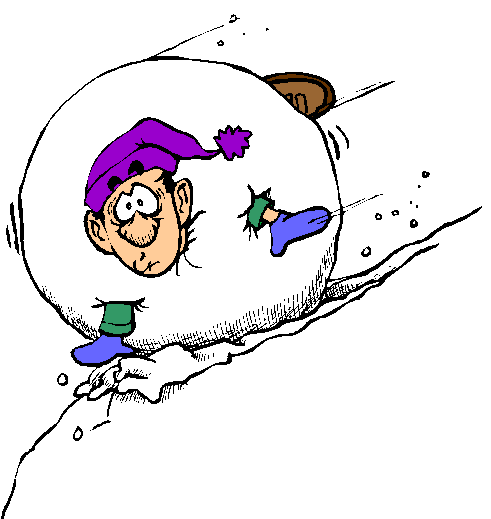
The verb, to “snowball” means for a situation to get bigger and bigger as time goes by. The reason the word “snowball” is used is because if we make a small snowball and roll it down a hill of snow, more snow will stick to it, and it will become much larger. Let me give you some examples of how to use “snowball” as a verb:

I made the mistake of offering to help a guy at my office with his report. Since then, the situation has completely snowballed. Now many of my co-workers are asking me for my help all the time!

I gave my son a Pokemon toy for his birthday, but now I regret doing that. It started off as one toy, but now the situation has totally snowballed. He has started collecting the toys, and now he wants a new one every week!

My friend started to write a short story about his family but soon after that, it really snowballed. He ended up writing a 400 page book about them.

The verb “snowball” is almost always used in the past tense and is usually used to describe negative situations that have gotten bigger and bigger over time. However it can be used to describe neutral situations as well, such as with the last example about the story becoming a book.

the difference between words: later and soon

later

Sometimes my students get confused about when to use “later” and when to use “soon”. This is especially confusing for them with the expressions, “See you later.” and “See you soon.” So I’d like to go over this in my blog today.

The word “later” is used to talk about a future time, but we don’t know exactly when in the future it will be. However, when we say “later”, it sounds like it will not be in the immediate future. The word “soon”, on the other hand, is used when something will happen in the immediate future, and usually the person has a general idea of when it will happen. For example:

A: I had a really nice time with you tonight. Let’s go out again sometime.

B: Ok. I’ll see you later. Bye.

_________________________________________________________________

A: We’re going to take a ten minute break now, and then we can finish talking about the project.

B: Ok, see you soon.

I don’t have time to write the report now, but I’ll do it later. I have lots of time because the deadline isn’t until next month.

I don’t have time to write the report now, but I’ll do it soon. The deadline is this Friday.

So, in the first example, the person says “See you later.” because they don’t know exactly when they will see the other person. The expression, “See you later.” is a friendly, casual way to say goodbye to someone. In the second example, the person says “See you soon.” because they know they will see the other person after a short time has gone by – in this case, after ten minutes.

In the third example, the person uses “later” because they don’t know exactly when they will write the report, but they know they have a fairly long period of time in which to do it. In the fourth example, they use “soon” because it must be done in the immediate future – in this case, before Friday.

idiom: to get the hang of something

getting_the_hang_of_it_558795

The idiom for this week is to “get the hang of” something.  This expression is used when we want to talk about becoming skillful at something after starting to do it for the first time. For example:

I know chess can be hard, but I’m sure you’ll get the hang of it eventually.

I don’t think I’ll ever get the hang of this new computer software. It’s so confusing!

At first, speaking Japanese was really hard for me, but I got the hang of it after a little while.

My grandmother tried to teach my mom how to knit, but she never got the hang of it.

Hey, I’m think I’m actually getting the hang of this new video game! I just scored 10,000 points!

When we use this expression, we use either the past tense (I got the hang of it), future tense (I will get the hang of it) or present continuous tense (I’m getting the hang of it). We can’t use the simple present tense with this expression.

Also, if we use it in the negative, it’s very common to use the word “never”. Therefore, we often say “She never got the hang of it.” or “I’ll never get the hang of it.” However, if we use the present continuous, we don’t use the word “never”. So, we would say “I’m not getting the hang of this.” Note that we use the word “this” instead of “it” because it’s happening at that moment.

I know that English idioms can be hard, but I’m sure you’ll get the hang of using them if you study hard!

separable phrasal verb: bump up (to)

Bump-Up-Logo1

Have you ever been selected to sit in business class or first class on an airplane even though you just had a ticket for the economy section? Well, if you have, today’s phrasal verb will be very useful for you. The phrasal verb “bump up” has two meanings:

1. to put someone in a higher group (usually on an airplane). For example:

I can’t believe it! The airline bumped me up to first class for my flight to Hawaii!

I was bumped bumped up to first class for my flight to Hawaii! (passive voice)

I’ve never been bumped up to business class or first class on a flight, but many of my friends have.

2. to arrange for an appointment to be earlier than scheduled. For example:

I’m afraid the doctor has to leave the office at 4:00, so we’d like to bump up your appointment to 2:30. Would that be alright with you?

My appointment was bumped up to 2:30. (passive voice)

We had to bump up the time for the meeting to 11:00 a.m. Could you please tell everyone about the change in schedule?

As you can see, the preposition “to” always comes between either the words “business class/first class” or the new time for the appointment.

grammatical expression: can’t help/couldn’t help

MV5BMTYyMDQyNzgxNV5BMl5BanBnXkFtZTcwNzIwOTI0MQ@@._V1_SY500_SX355_

Have you ever heard the old song “I can’t help falling in love with you”? Elvis Presley did the most popular version of it. Have you ever wondered what “can’t help” meant? Well, today that is what I’m going to write about.

The expression “can’t help” means that a person cannot control some kind of behavior that they do. So, in the case of the song, Elvis meant that he cannot control his feelings of love for the other person; he fell in love because he had no choice.

Here are some more examples:

You shouldn’t tease Rachel because of her acne. She’s a teenager, and she can’t help it if she’s got pimples.

Your uncle can’t help walking with a limp because his leg was injured in an accident a long time ago.

I got the hiccups during my exam, and I couldn’t help making a little noise.

I couldn’t help being late today. The trains were delayed for a long time because of an accident.

The first two examples use “can’t” because the situation which the person can’t control is still happening. The last two examples use “couldn’t” because the situation is now over.

adjective: dead

311e906b5d15be871e7bb23413e50c443d110f9c2e4691804cd2328a16796b20

I think everyone understands the main meaning of the adjective “dead” which is for someone or something to no longer be alive. However, many people don’t know that we can use the word “dead” in other situations. Let me go over them for you now.

1. for a place such as a restaurant or bar to not have many customers. For example:

The bar was dead on Saturday night, so we didn’t stay long.

The restaurant where my sister works has been really dead recently. She wants to find another job.

2. for a business deal to be cancelled. For example:

Our business partners backed out of our deal, so now it’s dead.

I thought our merger with ABC Company was dead, but they just told us they want to go ahead with it.

3. used to express that someone is in trouble with another person. For example:

I just broke my mother’s favorite vase! I’m dead when she gets home!

It’s because of Jim that we lost our biggest client! He is so dead when the boss finds out!

This last meaning of “dead” is only used in casual conversations because this meaning is a little bit slang.

It’s also important to know that when we use “dead” in the normal sense of someone or something losing life, we use the present tense, but not the past tense. For example:

My grandfather is dead now. He died about five years ago.

We CANNOT say: “My grandfather was dead.” because that would mean that he is alive again! Sometimes we say “was dead”, but only when the grammar demands it, such as when we use reported speech. For example:

Martin said his grandfather was dead.

So, these are the common ways to use the adjective “dead”.

grammatical word: eat

whats eating you meditating on beach 2

As I’ve done in the past, today I would like to go over a common verb which has other meanings that many people don’t know about. Today, the verb is “eat”. Of course, everyone knows the main meaning of this word which is to consume food. However, we can also use it in three other ways:

1. for some kind of public vending machine or payphone to take money and then not work properly. For example:

That drink machine ate my dollar. Is there someone in the building who can get me my drink or my dollar back?

The payphone ate my coin and then disconnected me! I hate it when that happens!

2. for something to require a lot of money in order to maintain it. For example:

My car is costing me a lot of money. Between parking costs and gasoline, it’s eating a lot of my monthly paycheck.

Having kids is so expensive. After my wife and I had our son, the cost of taking care of him really ate through our savings.

3. for something to put someone in a bad mood. For example:

Edgar and Henry just left the room as soon as I said hello to them. What’s eating them?

I just heard Charlene tell her friend to shut up! What’s eating her?

If you look at the fourth example, you’ll see that I used “eat through”. When talking about something that is reducing our savings, we often add the word “through” to the verb “eat”.

In the final meaning of “eat” which is for something to put someone in a bad mood, we almost always use “eat” in the question form, What’s eating + someone. Please be careful about saying it directly to a person, as in “What’s eating you?”. This is very strong and could be offensive to the person you are talking to.

the difference between words: put on, wear and take off

359668-dogs-putting-clothes-on-a-doggie.png

In English, we often have a special word or term that is used to describe the first part of an action. One of my previous blogs was an example of this: the difference between “find out” and “know”. As I explained before, first we find something out, and then we know it.

This is the same case for “put on” and “wear”: first we put something on, and then we wear it. For example:

The shirt you’re wearing now is really wrinkled. You should put on another shirt.

A: What do you put on first when you’re getting dressed in the morning?

B: I put on my underwear first of course! After that, I put on my pants.

I love what you’re wearing. It’s such a nice outfit.

It’s time to leave. Go and put on your coat because it’s cold outside.

I need to wear a heavy coat today because it’s very cold.

So the term “put on” refers to the time that we put a piece of clothing on our bodies. This is very fast and would usually take no longer than a minute. After the piece of clothing is completely on our bodies, we then say that we are wearing it.

When we talk about removing that piece of clothing from our bodies, we use the term “take off”. For example:

It’s time for a bath. Go and take off your clothes, and I’ll fill the bathtub with water for you.

I often take off my shoes when I’m sitting at my desk at work.

I don’t want to take off my coat because it’s really cold in the office today.

Please note that we don’t say “put off” when talking about removing clothes; we always say “take off”. Also, please note that in English, we use “put on”, “wear” and “take off” for any piece of clothing: hats, shirts, pants, shoes, socks, etc. We also use these terms for other things we put on our bodies such as jewelry, glasses and make up.

Newer entries » · « Older entries