grammatical word: wonder

index

For today’s blog entry, I’d like to write about the verb “wonder”.  It is used when we ask ourselves a question about something we want to know about. For example:

Kate was supposed to come to my party, but she didn’t. I wonder why she didn’t come.

I wonder how much Jake’s new car cost. It looks very expensive.

Cheryl invited us over for dinner on Saturday night. I wonder what she’s going to cook.

We can also use the verb wonder with the past progressive form (was + ing) as an introduction to a very polite request. For example:

I was wondering if you could help me with my project.

I was wondering if I could have the day off tomorrow.

My wife and I were wondering if you’d like to join us for dinner tomorrow night.

Sometimes people ask me why we have to use the past tense form (was). The reason is that the action of wondering started in the past. When you ask the question, the wondering is already over and the asking of the question is happening now.  As I mentioned before, when you use this, it’s very polite.

grammatical expression: get rid of

Bosses-Get-Rid-of-Employees-With-Too-Many-Bad-Habits

Today I’ve got another very useful and common expression for you: “get rid of”. This is used when we talk about wanting to dispose of something that we have. Therefore the thing is not something that we like, and we want it to go away. For example:

In this card game, you want to have all high cards like jacks, queens and kings, so you should try to get rid of your low cards as soon as possible.

I have an old TV that I need to get rid of. It still works. Would you like to have it?

I have a problem with ants in my kitchen. Do you know how I can get rid of them?

Brad and Jane are bringing over their children tonight, so please get rid of any sharp objects in the apartment. We don’t want the kids to hurt themselves.

Those old running shoes smell so bad!  Please get rid of them as soon as possible!

There are many ways of getting rid of something. We can throw it in the garbage (as with the running shoes), kill it (as with the ants), hide it (as with the sharp objects), give it away (as with the TV) or just stop holding it (as with the cards). As I said before, this is an extremely common expression in English, so I hope you’ll be able to use it now.  🙂

adjective: inevitable

images

The other day I was watching a TV show and one of the characters used the word “inevitable”, so that’s what I’d like to write about today. This adjective is used to talk about things which are impossible to stop or avoid. For example:

More immigration to our country is inevitable because our population is decreasing.

I’m afraid a tax increase is inevitable. The government just doesn’t have enough money right now.

When you study a language, making mistakes is inevitable, but you shouldn’t let that bother you.

Everyone dies eventually. Death is an inevitable part of life.

This word is often used with negative ideas such as tax increases, making mistakes or death but could also be used with neutral ideas such as immigration. It’s possible to use it with positive ideas, but that is quite rare with this word. It’s usually used when talking about serious things.

idiom: to talk shop

index

Today I have another useful idiom for you: “to talk shop”.  We use this idiom when two or more co-workers talk about their work together in their free time. For example:

When your co-worker comes over for dinner tonight, please don’t talk shop. It’s really boring for me.

Can we please not talk shop at the office party? I’d rather talk about other things.

I invited my friend from the office out for dinner last night, and all she did was talk shop. I wish she wouldn’t do that.

In our culture, “talking shop” has a rather negative feeling to it because most people want to talk about other things in their free time. What about you? How do you feel when your co-workers start talking shop when you’re not at work?

the difference between words: too and either/neither

eitherneither

Today, I have a blog entry for you about a common misunderstanding: the difference between “too” and “either”. Basically, it’s very simple: we use both “too” and “either” to say that something is also true for a second person or thing. The difference is that we use “too” for positive statements and we use “either” and “neither” for negative statements. For example:

I like pizza, and my wife does too.

I don’t like carrots, and my husband doesn’t either. 

A: I’ve been to Korea many times.

B: Oh really? I have too. What’s your favorite place in Korea?

_________________________________________________________________

A: I’ve never been to South America.

B: I haven’t either, but I’d really like to go there one day.

_________________________________________________________________

A: I can play the piano.

B: Oh really? Me too!

_________________________________________________________________

A: I can’t cook very well.

B: Me neither.

There is no difference in meaning between “either” and “neither”. We use “either” when there is  another negative word in the sentence such as “not” or “never”. For example:

A: I’ve never tried scuba diving.

B: Oh yeah? I haven’t either.

However, we use “neither” when there is no other negative word in the sentence. For example:

A: I’ve never tried scuba diving.

B: Oh yeah? Neither have I.

So, we can say “Neither have I.” or “I haven’t either.” but we CANNOT say: “I haven’t neither.” because there are two negative words in the sentence.

inseparable phrasal verb: live up to

rt

I think it’s time for another phrasal verb today, so I’d like to write about “live up to”. This is used when we want to talk about fulfilling another person’s expectation or following their example. For example:

My father has such high expectations for success. I could never live up to his expectations.

My father’s expectations for success can never be lived up to. (passive voice)

My mother is an amazing woman. I’ve tried hard all my life to live up to her example.

My idol is Nelson Mandela. Whenever I’m in a difficult situation, I try to live up to his example and rise above my anger and frustration.

So, as you can see from these examples, the person that you are trying to live up to is usually a high status person like a parent, teacher, politician, celebrity, etc.

grammatical word: should

sh

Today,  I’d like to write about a word that everyone knows very well: “should”. However, most people only know one meaning for this word. Most people don’t realize that it has another meaning which is commonly used. So, let me go over the two meanings:

1. it is used to give advice to people and to say that something is a good idea, but that they have a choice about whether or not to do it. (If there is no choice, we use “have to” or “must”.) For example:

If you’re not happy with your job, you should quit.

My sister is a little overweight. She should go on a diet.

My Japanese isn’t very good. I should study more.

2. the word “should” can also be used when we have an expectation that something will happen, but which is not guaranteed. For example:

My friend invited me to a party tomorrow night. It should be really fun.

Mr. Norton should be back in the office at 4:00. Can I have him call you back at that time?

I ordered a book on the Internet. It should be delivered by Friday.

In the examples for the second definition, if we use the word “will”, it means that the situation is 100% guaranteed. So, because we can’t guarantee the situation will come true, we use the word “should”.

grammatical expression: after all

aft

For today’s blog entry, I have another expression for you that is used a lot: “after all”. It is used when we want to give a reason for something, and the reason is very obvious or easy to understand. For example:

If our daughter wants to get married, we can’t stop her. She is a grown woman after all.

It’s the CEO’s right to sell the company if he wants to. After all, it is his company.

A: Wow, that Tim Burton movie was so weird. I didn’t expect that.

B: I don’t know why you’re so surprised. It is a Tim Burton movie after all.

We can also use “after all” to talk about the final part of a situation when the situation has changed. For example:

At first Caroline said she would come to the party, but she’s not going to come after all.

I know I said I would help you move this weekend, but I can’t do it after all. My boss just told me I have to go on a business trip on Friday.

At first, everyone in the office thought the new boss would be really strict, but he turned out to be a really nice guy after all.

In the case of the first meaning, “after all” can be place at the beginning or at the end of the sentence but , in the case of the second meaning, it is always placed at the end of the sentence.

idioms: to drive someone (crazy), (nuts), (up the wall), (around the bend)

res

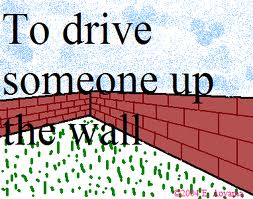
Today, I have four idioms for you that mean the same thing: “to drive someone crazy”, “to drive someone nuts”, “to drive someone up the wall”, and “to drive someone around the bend”. They are all used to talk about a person or a situation that really annoys us. For example:

My co-worker is always asking me to help her with her project! She’s really driving me crazy!

It drives me nuts when people cut in line when I’m at a store.

My roommate was driving me up the wall because he was always playing his music really loudly. Eventually, I asked him to move out.

My car is often breaking down when I’m driving. It’s driving me around the bend.

In all of these examples, the person feels extremely annoyed by the person or situation. The last three examples are a little more casual than the first one, “to drive someone crazy”. However, all the expressions are used in casual conversations.

adjective: weird

olj

The adjective for today is “weird”. This means the same thing as “strange”, but it is more casual. For example:

I saw a really weird movie last night. I didn’t like it very much.

My new co-worker is so weird. She’s always asking people what their favorite animal is.

I love that new store in the shopping mall. They sell a lot of weird stuff there.

Generally speaking, the words “strange” or “weird” are negative, as in the first two examples. However, sometimes  they can be neutral or positive in meaning, as in the third example. In that sentence, the person likes the stuff the store sells because they are unusual items, and that person likes that. In this sentence, the word “stuff” has the same meaning as “things”.

Newer entries » · « Older entries