Archive for grammatical expression

grammatical expression: in lieu (of)

Today I’d like to write about an expression that I was teaching to some of my students just before the holiday. The expression is “in lieu” and it is usually followed by the preposition “of”. It basically has the same meaning as “in place of”. We use it when we want to talk about replacing a customary activity with another activity. Let me give you some examples:

For my grandfather’s funeral, my family would like people to send a donation to cancer research in lieu of sending us flowers.

In order to celebrate my father’s birthday, my family and I decided to have a quiet dinner at home in lieu of a big party.

This store gives customers discounts on future purchases in lieu of refunds.

My friend does various jobs for his landlord in lieu of paying rent.

A: Do you get paid extra for overtime work at your company?

B: No, my company doesn’t do that. They give us time in lieu instead.

In the case of this last example, “time in lieu” is a set expression which means that the person will receive time off from work in the same amount of overtime that was worked. This system is often used by companies that can’t afford to pay overtime to their employees. So, if a person works eight hours of overtime, they will get one day off in lieu of being paid overtime.

By the way, the pronunciation of the word “lieu” is /lew/.

grammatical expression: …is more like it

The expression for today, “… is more like it”, has two completely different meanings. This first one is used when we are correcting someone about some information they have just given. For example:

A: And then we had to walk for about five kilometres.

B: Five? I don’t think so. Ten kilometres is more like it.

_________________________________________________________________

A: I think it will cost you about $1500 a month to rent an apartment downtown.

B: I think that’s too low of an estimate. $2000 a month is more like it.

_________________________________________________________________

A: My friend is quite pretty.

B: Quite pretty? No way! I would say very beautiful is more like it!

We often use this expression when talking about numbers like prices, statistics, etc. However, we can also use it when describing people or things, as in the last example.

The second way to use this expression is when we are in a situation we are not satisfied with. If it is then corrected to our satisfaction, we often say “That’s more like it!” We always use the word “that” as the subject.

For example, imagine you were in a very loud bar and don’t like it. You then move to another bar which is much quieter:

A: That’s more like it. Now we can talk easily.

B: Yes, I agree. This place is much better.

Now imagine you’re in a restaurant and you’ve ordered a steak well done. When it comes it has been cooked medium. You send it back to the kitchen to be cooked more. When it comes back, it is now cooked well done:

A: That’s more like it. Thank you for taking it back to the kitchen.

B: I’m very sorry about the mistake, sir.

So, in these situations, “more like it” means “better” or “more the way I like it”. Please be careful not to say this directly to another person who has made a mistake about something because it could sound very rude.

grammatical expression: a slew of

Today’s expression comes straight from the news. Just before I logged on to my blog site, I was reading an article about president Obama, and in it they used today’s expression: “a slew of”. This basically has the same meaning as “a lot of”. For example:

I have a slew of DVDs in my apartment that I haven’t watched yet.

President Obama has had a slew of victories in his first two years in office.

There has been a slew of complaints about our new product. People really aren’t happy with it.

My son has a slew of old toys that he needs to get rid of. Do you know anyone with a young child we can give them to?

There is a slight difference between “a lot of” and “a slew of”. First of all, “a slew of” is less commonly used than “a lot of”. Therefore, when we say it, it sounds stronger than “a lot of”. Secondly, we can use “a lot of” with both countable and uncountable nouns. However, we usually use “a slew of” with countable nouns only. As you can see from my examples, all of the nouns are countable.

grammatical expression: with my luck

POPS24_FR_C_^_FRIIQ

It’s time for another grammatical expression. I really like writing about these because I don’t think they’re usually taught, but they’re extremely important. I often use today’s expression; it is “with my luck”.

It’s used when we want to express pessimism about some project or activity that we are planning to do. For example:

I’m planning to go on a picnic tomorrow but, with my luck, it’ll end up raining.

It’s possible that I’ll get a promotion this year but, with my luck, it will go to someone else.

A: Do you think there will still be tickets left for the concert?

B: With my luck, probably not! But I’ll still call to find out.

I’m going on a blind date tonight with my friend’s cousin. With my luck, she’ll be old and fat though.

So, this expression can be used in a serious way, as in the first three examples or as a kind of joke, as in the last example. It’s always used about a situation that will happen in the future. Most English speakers use this expression sometimes even if they’re not extremely pessimistic people. Using this expression is more like a common habit we have, so you shouldn’t take it so seriously when you hear a native English speaker using it.

grammatical expression: I’m dying to…

IMG_5032

Sometimes we use the words “dead” or “die” in various expressions in English. I wrote about “dead” before and mentioned that we can use it to describe a place like a bar or restaurant where there are not many customers. Today’s expression, “I’m dying to…” uses the word “die” but is quite different in feeling.

We use “I’m dying to” do something when we want to talk about something that we want to do very much. For example:

I’m dying to see the new Johnny Depp movie! It’s supposed to be really good!

I’m dying to go to Paris! I’ve always wanted to see the Eiffel Tower up close.

My wife and I are dying to try that new Thai restaurant! We love Thai food!

I’m dying to get out of the office! This has been such a hard day at work!

So, when we use this expression, it’s usually for a positive situation such as in the first three examples. However, sometimes this situation can be negative such as in the last example of the person wanting to leave the office because it was a hard and stressful day.

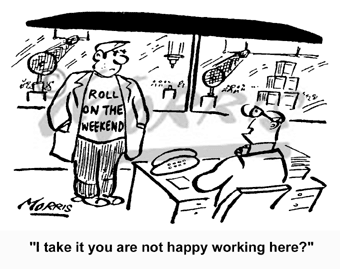
grammatical expression: I take it…

6479bwc

Today’s grammatical expression is another commonly used one which uses a verb with many meanings – “take”. In this case, the expression is “I take it…” It is used when we want to say that we assume some information to be true based on something another person has just said. For example:

A: My girlfriend wants me to go dancing with her! Uh! I can’t believe it!

B: I take it you don’t like to dance then.

________________________________________________________________

A: It’s so hard to find shoes that fit my husband.

B: He’s got large feet, I take it.

________________________________________________________________

A: My daughter started screaming when I put her into the swimming pool.

B: I take it she’s afraid of water.

________________________________________________________________

A: Hi there! I just got back from from vacation.

B: Well, you’re smiling and look very relaxed, so I take it you had a good time.

Sometimes, as in the last example, the clue that we receive can be visual instead of something that the person says. In the last example, the second person assumes the first person had a good time based on the way the first person looks.

grammatical expression: talk about…

ab

Today’s expression is another common one which is only used in casual conversations. It is “talk about…”, and it is used when we want to express our feelings about someone or something in a stronger way. It’s similar in use to “What a” + adjective + noun  or “How…” + adjective. For example:

My friend just took me out for an expensive lunch for no special reason. Talk about a nice guy!

Sam always works at least until 10:00 pm every night, and sometimes on weekends. Talk about a hard worker!

I just saw a girl throw up all over someone on the subway. Talk about disgusting!

I had a meeting yesterday that lasted for five hours! Talk about boring!

As I mentioned before, this is similar to “What a…” or “How…”, so the examples above mean the same thing as “What a nice guy!”, “What a hard worker!”, “How disgusting!” and “How boring!” The difference is that “Talk about…” is more casual and I think more commonly used.

grammatical expression: tell me about it

tell-me-about-it-600-sq

We have a few different ways to show agreement with someone else in English. Today’s expression “tell me about it” is one of them. We use it when we want to indicate to another person that we completely understand and agree with a statement they have just made. For example:

A: The summers in Tokyo are so hot and humid.

B: Tell me about it! I sweat like a pig every summer here.

________________________________________________________________

A: The new video game from ABC Company is terrible.

B: Tell me about it! I just bought it and I think it’s really boring.

________________________________________________________________

A: In high school, chemistry was so hard for me.

B: Tell me about it! It was my worst grade in high school.

So, as you can see from the examples, we use “tell me about it” to express the fact that we have had the same experience as the other person and we completely agree with them about it. Generally speaking, we use it when the first person has used an adjective to describe the situation as in the examples: “hot and humid”, “terrible” and “hard”.

grammatical expression: out and out

OutAndOut

Today’s expression is “out and out”, and it has the same meaning as “completely” or 100%. Let me give you some examples of how to use it.

My neighbor is out and out crazy. He believes that there are aliens in the city walking around disguised as humans.

That company has been using child labor to manufacture its products. It’s out and out unethical.

Georgio’s is out and out the best Italian restaurant I’ve ever been to.

You told me that you were having dinner with your father, but I called him and you weren’t with him! That was an out and out lie!

We usually use this expression with adjectives, as in the first three examples. However, sometimes it can also be used with a noun, as in the last example.

We use it with adjectives that describe our view or opinion of a situation or person. We don’t use it with adjectives that describe something physically. So, we CAN’T say, “My apartment is out and out small.” We also don’t use it with adjectives like “good” and “bad”, but we can use it with “the best” or “the worst”.

grammatical expression: not that…

einstien-quote

I have another very common expression that I’d like to write about today. This is another one that English speakers use all the time in conversation but, as far as I know, nobody ever teaches it. It is “not that” followed by a particular sentence. It is used when we say something to another person and then we think they may have gotten the wrong idea about us based on that statement. We say “not that” followed by another sentence to make sure they didn’t misunderstand what kind of person we are. For example:

Sometimes I play video games, not that I’m a computer geek or anything like that!

I went to see a French movie with my girlfriend, not that I like foreign films. She made me go with her!

I work a lot of overtime for my job, not that I want to. I have no choice.

I memorized all the Chinese characters and their meanings in this book, not that it was easy for me. It took me a long time to do it.

My husband has agreed to help me with the party, not that he had a choice. I told him I wouldn’t cook for him unless he helped me.

So, in these examples, the statement that follows “not that” indicates that I’m not a computer geek, I don’t like foreign films, I don’t want to work overtime, memorizing the Chinese characters was not easy for me, and that the husband didn’t have a choice about helping with the party. As I mentioned at the beginning, the person says these things to ensure the other person doesn’t misunderstand.

This is a very common expression. If you haven’t heard it before, I hope you’ll now be able to notice when English speakers use it.

Next entries » · « Previous entries