idiom: to have a bone to pick with someone

dog_with_bone

If you’ve ever been a little angry with someone and wanted to tell them directly what they did to annoy or anger you, you can use today’s idiom: to “have a bone to pick with” someone. It is used when we want to talk about being angry or annoyed with another person. For example:

I have a bone to pick with you! You completely ignored me at the party last night! Why did you do that?

I have a bone to pick with Susan. She didn’t finish her report on time and it caused a big delay. I’m going to talk to her about it later.

What’s wrong? Why aren’t you talking to me? If you have a bone to pick with me, just tell me!

If we use this when speaking to someone directly, it’s a little strong, but it’s a common way to indicate that you’re annoyed with someone before you tell them what it’s about. The level of your anger will be indicated by your tone of voice. If your intonation goes down, you will sound very angry, but if it’s kept up, it will indicate that you’re just annoyed about something.

separable phrasal verb: point out

how-to-point-out-mistakes-made-when-speaking-english

Today, I’d like to write about the phrasal verb “point out”. We use this expression in two ways in English.

1. to indicate where something is by pointing. For example:

I don’t know which building city hall is. Could you point it out to me please?

My new co-worker didn’t know who the boss was, so I had to point him out for her.

2. for someone to indicate a problem with someone else’s idea. For example:

It’s an interesting business idea you have. I hate to point this out to you, but you don’t have enough money to open a business.

It was pointed out to me that we don’t have enough money to open a business. (passive voice)

We decided to have dinner before the movie because my friend pointed out that it was about three hours long. It would be too late to eat dinner afterwards.

When we use this expression directly to someone, we often say “I hate to point this out, but…” because we’re going to say something negative and it’s softer to say it in this way.

grammatical expression: talk about…

ab

Today’s expression is another common one which is only used in casual conversations. It is “talk about…”, and it is used when we want to express our feelings about someone or something in a stronger way. It’s similar in use to “What a” + adjective + noun  or “How…” + adjective. For example:

My friend just took me out for an expensive lunch for no special reason. Talk about a nice guy!

Sam always works at least until 10:00 pm every night, and sometimes on weekends. Talk about a hard worker!

I just saw a girl throw up all over someone on the subway. Talk about disgusting!

I had a meeting yesterday that lasted for five hours! Talk about boring!

As I mentioned before, this is similar to “What a…” or “How…”, so the examples above mean the same thing as “What a nice guy!”, “What a hard worker!”, “How disgusting!” and “How boring!” The difference is that “Talk about…” is more casual and I think more commonly used.

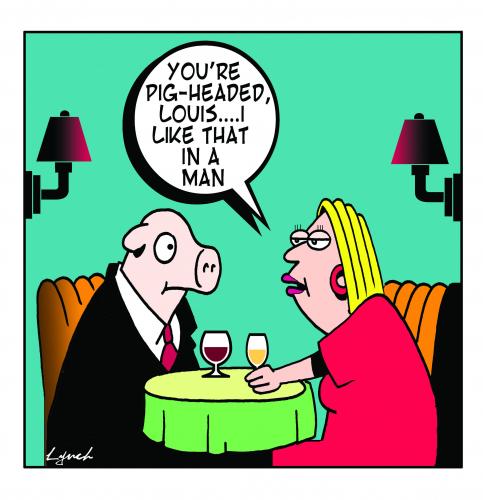
adjective: pig-headed

pig_headed_99535

Today, I have a nice short entry for you about the adjective “pig-headed”. It has the same meaning as the word “stubborn”, except that it’s more negative. If you’re not sure what the word “stubborn” means, it is used when we want to talk about a person who makes a decision about something and then refuses to change their mind about it no matter what.  Let me give you some examples:

My father is so pig-headed! He refuses to go see a doctor even though he’s very sick! I don’t know what to do with him!

My daughter has been wearing the same jeans for over a week now! I tried to ask her to let me wash them, but she absolutely won’t do it! She’s so pig-headed!

I don’t think we will be able to get a better deal in the negotiations. I’ve heard that the president of the company is very pig-headed.

Generally, we don’t call ourselves “pig-headed” because it sounds very negative. However, it’s ok if we call ourselves “stubborn”. Also, you don’t want to call another person “pig-headed” directly to their face because they might get angry.

grammatical word: bug

DBM2

The word “bug” in English is commonly used in casual conversations. It can be used as a noun and as a verb. As a noun, it’s a more casual word for “insect”. For example:

So many bugs get into my house in the summer. I really hate them!

Some kind of bug bit me, and now I have a mark on my skin.

My son likes to catch bugs and put them in a jar.

As a verb, it has the same meaning as to “bother” someone. For example:

I hope I’m not bugging you, but I really need your help with my project.

What’s bugging Jennifer? She’s in a really bad mood today.

It really bugs me when people cut in line or spit on the street.

As I mentioned already, this word is used in casual conversations. If you want to sound more formal, you should use “insect” or “bother”.

the difference between words: realize and understand

realize char front (Medium)

Some people get confused between the meanings of “realize” and “understand”, so I’m going to write about that today.

In English, we use the word “realize” when we think about something that is confusing for us and then suddenly know its true meaning. We can also use “realize” when we suddenly discover the reality of a situation that we didn’t know before because something happens to make us understand it.

We use “understand” when we can comprehend information or a situation. For example:

After I thought about it for a long time, I realized I would have to get an education if I wanted to be successful in life.

I didn’t realize that restaurant was so popular until my friend and I went there. We had to wait 45 minutes to get a table!

I realized that I had left my cell phone at home when I put my hand in my pocket.

I first realized how hard it is to speak another language when I took a Spanish class about five years ago.

I understand why Jim is so angry about not getting a promotion because the same thing happened to me.

I didn’t understand the meaning of that word, so I looked it up in a dictionary.

I understand philosophy because it was my major at university.

A: Do you understand what Carol is talking about?

B: No, she’s always talking about science, so it’s over my head.

So, with the examples for “realize” we use that word because the person comes to know the reality of the situation because they think about it for a long time, they go to the restaurant and see that it’s popular, they feel their cell phone is not in their pocket and they take a Spanish class and have a hard time with it.

In the last example for “understand” I use the idiom to be “over someone’s head”. I wrote about this idiom before, but if you don’t remember the meaning, you can check my blog entry for March 28, 2010.

idiom: to bend over backwards

bending_over_backwards

Have you ever tried really hard to please someone? If so, you can use today’s idiom to describe that situation. We can use the idiom to “bend over backwards”, when we want to talk about making a big effort to make another person happy. For example:

I really liked the service at the hotel where I stayed in Singapore. The staff just bent over backwards for me.

I can’t believe how ungrateful my husband is! I bend over backwards to cook and clean for him, but he never appreciates anything I do!

A: I hope I get a promotion this year.

B: I’m sure you will. You bend over backwards for everyone in this office, and I’m sure you boss has noticed that.

I’m so angry right now! I invited my friend to dinner last night. I bent over backwards to make a nice dinner for her, but then she cancelled at the last minute!

So when we use this expression, the effort that we make for the other person can either be appreciated or not. If we make a big effort for someone but the result is that they don’t care about our effort, we always use the word “but” in the sentence (as in the second and fourth examples).

separable phrasal verb: talk into

670px-Persuade-People-with-Subconscious-Techniques-Step-4

The phrasal verb for today is an easy one, and it’s also very commonly used in English. It is “talk into”. We use it when we want to talk about persuading someone to do something that they previously did not want to do. For example:

At first, Gary didn’t want to come to the party, but Jim managed to talk him into it.

Gary was talked into coming to the party by Jim. (passive voice)

A: Karen says she doesn’t want to help us with this project.

B: Let me speak to her. I think I can talk her into helping us.

I tried to convince my husband to go to Paris for our vacation, but he wouldn’t listen. I’ve never been able to talk him into anything. He’s so stubborn!

Ben is such a persuasive person. He can talk anybody into anything!

This expression can only be used about situations where someone is talking to another person face to face or on the telephone. If someone who is on the radio or on TV persuades a person to do something, we don’t use this idiom to describe that situation. Instead, we would use the verbs “persuade” or “convince”.

grammatical expression: tell me about it

tell-me-about-it-600-sq

We have a few different ways to show agreement with someone else in English. Today’s expression “tell me about it” is one of them. We use it when we want to indicate to another person that we completely understand and agree with a statement they have just made. For example:

A: The summers in Tokyo are so hot and humid.

B: Tell me about it! I sweat like a pig every summer here.

________________________________________________________________

A: The new video game from ABC Company is terrible.

B: Tell me about it! I just bought it and I think it’s really boring.

________________________________________________________________

A: In high school, chemistry was so hard for me.

B: Tell me about it! It was my worst grade in high school.

So, as you can see from the examples, we use “tell me about it” to express the fact that we have had the same experience as the other person and we completely agree with them about it. Generally speaking, we use it when the first person has used an adjective to describe the situation as in the examples: “hot and humid”, “terrible” and “hard”.

adjective: down-to-earth

DownToEarth (3)

Today I have a good adjective to describe someone’s personality – “down-to earth”. It is used to describe a person who doesn’t have any qualities that would make it difficult to talk to them. People who are “down-to-earth”  have a lot of common sense, and it’s easy for regular people to relate to them. For example:

I don’t like Jeremy anymore. Before he went to university, he was so down-to-earth and fun, but now he just talks about philosophy. I can’t relate to him at all now.

I would describe my husband as very down-to-earth. It’s easy to talk to him, so he has a lot of friends.

I really like Tom Hanks. Other actors seem really pretentious and conceited, but he seems really down-to-earth. I feel like he’s someone I could have a beer with.

I hope the meaning of this adjective is clear. It’s very commonly used to describe people’s personalities in English.

Newer entries » · « Older entries