Archive for December, 2010

adjective: tacky

tumblr_mepb8xeOof1qim2yn

The adjective for this week is one that is used in casual conversations; it is the word “tacky”. It is used when we want to describe something or someone as being in bad taste. For example:

Did you see that tacky dress that Noreen was wearing yesterday? It was purple and green and had pictures of horses all over it!

If I were you I wouldn’t wear running shoes with a dress. It’s really tacky.

Mark often tells tacky jokes about sex at the office. I wish he wouldn’t do that.

Don is always bragging about his girlfriend and saying what big breasts she has. It’s so tacky!

I don’t want to buy my sofa at ABC Store because all of the furniture they sell is really tacky.

The city decided to put up a statue of a Greek god in the middle of the downtown area! I can’t believe they would do such a tacky thing!

So we can use the word “tacky” to describe either a person’s clothes or the things they say, as in the first four examples. It can also be used to describe things of bad taste in general, as in the last two example. In all cases, the word “tacky” is negative.

grammatical word: happen

cp,375x360,s,ffffff.u1

Today’s word, “happen” is yet another example of a word which has more than one meaning that many people don’t know about. Of course, the first meaning is for some kind of situation to take place. For example:

Something really interesting happened today at my office.

Has anything new happened with the ABC project?

However, we can also use happen when asking questions to people, but when we use happen in the question, it means that we think it’s less likely that the person has the information or thing we want. For example:

Do you happen to know where I can find German beer in this city?

Do you happen to know when the last train leaves?

Do you happen to have a tape measure? I need to measure something.

Do you happen to have an extra copy of that book? I’d really like to read it.

So, in these examples, the person says “happen” in the question because they think it’s not so likely the person knows where to find German beer, knows when the last train leaves, has a tape measure or has an extra copy of the book; however, they are asking the question anyway on the slim chance the person can help them.

If we think it’s more likely or even probable that the person can help us, we don’t use “happen”. For example:

Do you know where I can find German beer in this city?

Do you know when the last train leaves?

Do you have a tape measure? I need to measure something.

Do you have an extra copy of that book. I’d really like to read it.

We can use “happen” in the past tense in regular sentences to describe a situation that occurred by chance. For example:

When I was shopping for my mother’s birthday present, I happened to find a really nice shirt that fit me, so I bought it.

I wasn’t trying to listen to your conversation. I just happened to overhear you say that you’re going to quit your job. Why are you going to do that?

By saying “happen” in these sentences, the person is stressing that the situation occurred by accident.

We can also use “happen” in the present tense when we want to emphasize something and make another person aware of it. For example:

A: I really don’t like lawyers.

B: Oh really? Well, I happen to be a lawyer!

_________________________________________________________________

A: Did you taste this pie? It’s really bad.

B: That just so happens to be my pie!

In these cases, person B is offended by person A’s remark and wants to make them aware of it, so they use “happen” for emphasis.

the difference between words: practice, train and exercise

images

Many people get confused about when to use “practice”, “train” and “exercise”, so that’s what I’m going to write about today.

The word “practice” is a word that describes doing an activity repeatedly in order to  become more skillful at it. The word “train” can be used to describe learning new skills for your job or putting your body into very good physical condition in order to be an athlete such as a boxer. Finally, the word “exercise” is used to talk about moving your body so as to get into or stay in good physical condition. Let me give you some examples:

I can’t play the piano well. I need to practice more.

If you want to speak English well, you have to practice as much as possible.

My son is good at basketball because he practices all the time.

I have to train more with this new computer software at my office. I’m still not sure how to use it properly.

I would like to train to become a member of the marketing team.

My friend wants to become a boxer, so he is training all the time right now.

I want to lose weight, so I have to exercise more.

I exercise about three times a week at the gym near my apartment.

I love to exercise! It makes me feel better after a stressful day at work.

The difference between “train” and “exercise” is that we only use the word “train” when a person is exercising a lot in order to become an athlete. Therefore, the majority of people use the word “exercise”.

idiom: to beat around the bush

dont_beat_around_the_bush_greeting_card-r9affaf88eed64b84b3349ca6183bacfc_xvuak_8byvr_512

If you know anyone who tends to talk in circles and never comes to the point, you can use today’s idiom to describe them. To “beat around the bush” is used to talk about people who talk about something indirectly but won’t say the important point directly. For example:

What are you trying to tell me? Stop beating around the bush and just say it!

My boss tends to beat around the bush if he has bad news to give us. I wish he wouldn’t do that.

My friend really hates confrontation, so he always beats around the bush if he has something negative to say.

When people “beat around the bush”, it’s usually because they have something negative to say and are trying to avoid saying it. However, it can also describe people who have a general habit of talking in circles and not saying things directly. In English speaking culture, to “beat around the bush” is considered a negative thing to do.

intransitive phrasal verb: let up

2012-10-04-rain

The phrasal verb for today is “let up”, and it is used in two different ways in English.

1. for a bad weather condition to stop (often rain). For example:

It’s been raining hard all day, and the forecast says it won’t let up until tomorrow.

It looks like the rain is starting to let up, so we can finally walk home.

If the storm lets up by tonight, we can go to the party.

2. for someone to decrease the intensity of their treatment of another person. For example:

When my father gets angry, he starts to yell, and he doesn’t let up for a long time.

My mother and father have really been pressuring me to get married. I wish they would just let up.

My friend has been asking me to lend him money, and he just won’t let up. It’s really annoying!

So, in both cases, the phrasal verb “let up” has the meaning of “stop”. In the first case, it means for a bad weather condition to stop, and in the second case, it means for someone’s difficult behavior towards another person to stop.

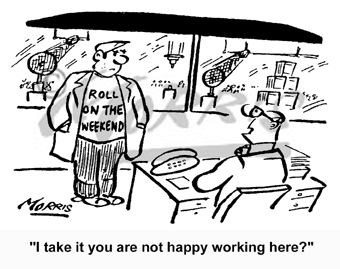
grammatical expression: I take it…

6479bwc

Today’s grammatical expression is another commonly used one which uses a verb with many meanings – “take”. In this case, the expression is “I take it…” It is used when we want to say that we assume some information to be true based on something another person has just said. For example:

A: My girlfriend wants me to go dancing with her! Uh! I can’t believe it!

B: I take it you don’t like to dance then.

________________________________________________________________

A: It’s so hard to find shoes that fit my husband.

B: He’s got large feet, I take it.

________________________________________________________________

A: My daughter started screaming when I put her into the swimming pool.

B: I take it she’s afraid of water.

________________________________________________________________

A: Hi there! I just got back from from vacation.

B: Well, you’re smiling and look very relaxed, so I take it you had a good time.

Sometimes, as in the last example, the clue that we receive can be visual instead of something that the person says. In the last example, the second person assumes the first person had a good time based on the way the first person looks.

adjective: funny

index

I’ve written about the adjective “funny” before in my blog about the difference between “fun”, “funny” and “interesting”. At that time I only mentioned the first meaning of “funny” which is something that makes us laugh.

However, there is another meaning to this word that many people don’t realize. It can also be used to describe things which are odd or a little strange. For example:

There’s a funny smell coming from the kitchen. I wonder what it is.

This soup tastes funny. What did you put in it?

There’s something funny going on at my office. I see people whispering together, but nobody will tell me what’s happening.

A: Bill said he could come to our party.

B: That’s funny. He told me he couldn’t come.

I’m now married with three kids. It’s funny because I never thought I would start my own family.

So in this way, the word “funny” can be used to describe a strange taste or smell or a surprising situation which we think is a little strange.

Next entries »