Archive for adjectives

adjective: practical

A little while ago, I wrote about the adverb “practically”. Today, I would like to write about the adjective form “practical”. You would think that they basically have the same meaning, but they don’t.

The adverb “practically” is usually used to mean “almost”, but the adjective “practical” is usually used when we want to describe a person or a thing as displaying useful thinking. When we describe a person as “practical”, it means they think about how things can be used for a useful purpose. When we describe a thing as being “practical”, it means that it can be used for a useful purpose. For example:

My daughter always carries a Swiss army knife in her bag. She’s so practical!

My husband is very good at thinking of various uses for old pieces of wood. He’s extremely practical in that way.

My mother always gives people very practical gifts like coffeemakers or can openers.

I don’t think I learned a lot of practical things in high school. My sister took home economics, and she learned more practical things like how to cook and sew.

My French teacher taught me how to say a lot of practical questions such as “Where is the bathroom?” and “How much is this?”

We can also use the word “practical” to talk about things that are connected to real life experience rather than theory. For example:

This new software will have a lot of practical applications.

I got a lot of practical experience by working as a waiter in a restaurant. I think I know more about the restaurant business than most people studying about it in school.

It is possible to use “practically” with this meaning but, in my opinion, it’s not so common. For example, it’s possible to say something like, “We must think about this practically.” However, I think most people would say, “We must think about this in a practical way.” To me, using “practical” sounds more natural.
adjectives: competent/incompetent


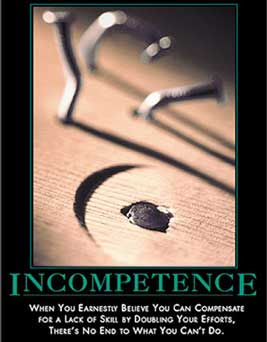
Today I’d like to write about the adjective “competent” and its opposite “incompetent”. These words are used to describe a person’s ability to do their job. If a person is able to do their job well, we say they are competent. On the other hand, if a person cannot do their job well and are constantly making mistakes, we say they are incompetent. For example:

Nathan is a very competent engineer, so I think we should ask him to lead this project.

A: Who’s the most competent person in your department?

B: I would say it’s Justin. He’s extremely competent at his job.

Paul is very competent when it comes to computer programming, but he’s not so competent when it comes to organizing the schedule.

Our company has a new president who’s completely incompetent. His bad decisions have cost our company a lot of money.

Jackie was fired yesterday because she was completely incompetent at her job.

I do all the cooking at my house because my wife is totally incompetent in the kitchen.

It’s important to note that we cannot use the word “competent” about jobs that are more artistic in nature because the word sounds very technical. Therefore, we would NOT say, “She’s a very competent artist.” Instead, we would choose a word with more emotion in it. For example, “She’s a wonderful artist.” or “She’s an amazing artist”. If we used the word “competent” in that situation, it would not sound like a compliment.

Also, if we simply say a person is “competent” at something, it doesn’t sound extremely positive. It’s like saying, “He has the required skills to do the job.” If we want it to sound more positive, we put words like “very”, “totally”, “completely” or “extremely” in front of “competent”.  Then it will sound much more positive.

Finally, please be careful not to use the word “competent” directly to another person. If we say “You are very competent at your job.”, it doesn’t sound very good because it’s very technical and there’s no emotion in the statement. Therefore, we always use it when talking about other people who are not there at the moment.

adjective: sensible

am

Today, I would like to go over the adjective “sensible”. It is used to talk about a person or action that shows good sense. Another way to say that is that the person or action shows logical thinking that will help avoid problems. For example:

Jill is a very sensible girl, so I’m sure she’ll choose a career that will allow her to earn a good salary.

My wife is very sensible when it comes to money, so we can save a lot every month.

You want to quit your job to become a musician?! Please be sensible! That would be a big mistake!

You didn’t bring a jacket with you when you went hiking? That wasn’t very sensible, was it?

Make sure you take a pair of sensible shoes with you on your trip. You’ll need shoes that will be comfortable.

In the last example, I used the word “sensible” to describe the shoes rather than the person or the action. This is a special case. We often say “sensible shoes” to talk about shoes which are flat and comfortable for the person to wear. We use the word “sensible” because the person’s action of wearing such shoes is logical and shows good sense.

adjective: fishy

Today’s adjective has two meanings. One of them is very obvious, and the other is a little more surprising. The word is “fishy”.

The first meaning is for something or some place to smell like fish. This is usually considered bad even if we like fish. For example:

Last time I went to the fish market that fishy smell stayed in my clothes for a whole day.

My friend’s apartment smells really fishy right now. She must have been cooking it recently.

I like eating salmon because it doesn’t have a strong fishy smell.

The second meaning for “fishy” is that a certain person or situation is suspicious. For example:

 I didn’t go into business with that company because they seemed really fishy to me.

There’s something fishy about that guy. I don’t trust him.

There’s something fishy going on! Jack and Bill both asked me how I’m doing, but they never talk to me! What’s going on?

Just as a side note, you might be interested to know that the word “fish” does NOT take an “s” in its plural form. Therefore, we do NOT say “fishes”; instead we would say “I have five fish.” Two other animals that follow this same rule: sheep and deer. For example:

I saw two sheep at the zoo.

There are many deer in Nara, Japan.

Please don’t ask why “fish”, “sheep” and “deer” don’t take an “s”; it’s just one of those strange things in English we have to remember.

adjective: obnoxious

I have a nice short entry for you today. The adjective for this week is “obnoxious”, and it can be used to describe a very annoying person whose behavior is extremely offensive or irritating. For example:

A: Frank was so obnoxious at the party last night. He kept yelling in people’s ears and spilling drinks on them.

B: He must have been drunk. He’s always obnoxious like that when he gets drunk.

There were some really obnoxious kids sitting next to us at the restaurant last night. They were running around and screaming the whole time. I hate kids like that!

I hate Carla. She really looks down on me because I didn’t go to university. The other day, she tried to embarrass me by asking me questions she knew I wouldn’t know the answers to. She’s so obnoxious!

This word is quite strong and is usually only used about people. If you want to use a softer word, you can say “annoying”.

adjective: stuck up

It’s Wednesday today, and that means it’s time for another adjective. The word for today is actually a combination of two words: “stuck up”. It is used when we want to talk about a person who is snobby and conceited. In other words, someone who thinks he or she is better than other people. For example:

I tried to ask Tammy out, but she wouldn’t even talk to me. She’s so stuck up because she’s pretty.

The kids that go to private schools tend to be a little stuck up, so I don’t want my son to go to a private school. I want him to be more down-to-earth.

Ever since Bill got a promotion, he’s gotten a bit stuck up. It’s a shame because he used to be such a nice guy.

A: I saw an interview with the famous model Helen Jacobson on TV yesterday, and she came across as really stuck up.

B: That shouldn’t be such a surprise. I think most models are stuck up.

So, we often use this word to describe people who think they’re better than others based on the way they look, but it’s possible to use it based on other things like money and education.

adjective: tacky

tumblr_mepb8xeOof1qim2yn

The adjective for this week is one that is used in casual conversations; it is the word “tacky”. It is used when we want to describe something or someone as being in bad taste. For example:

Did you see that tacky dress that Noreen was wearing yesterday? It was purple and green and had pictures of horses all over it!

If I were you I wouldn’t wear running shoes with a dress. It’s really tacky.

Mark often tells tacky jokes about sex at the office. I wish he wouldn’t do that.

Don is always bragging about his girlfriend and saying what big breasts she has. It’s so tacky!

I don’t want to buy my sofa at ABC Store because all of the furniture they sell is really tacky.

The city decided to put up a statue of a Greek god in the middle of the downtown area! I can’t believe they would do such a tacky thing!

So we can use the word “tacky” to describe either a person’s clothes or the things they say, as in the first four examples. It can also be used to describe things of bad taste in general, as in the last two example. In all cases, the word “tacky” is negative.

adjective: funny

index

I’ve written about the adjective “funny” before in my blog about the difference between “fun”, “funny” and “interesting”. At that time I only mentioned the first meaning of “funny” which is something that makes us laugh.

However, there is another meaning to this word that many people don’t realize. It can also be used to describe things which are odd or a little strange. For example:

There’s a funny smell coming from the kitchen. I wonder what it is.

This soup tastes funny. What did you put in it?

There’s something funny going on at my office. I see people whispering together, but nobody will tell me what’s happening.

A: Bill said he could come to our party.

B: That’s funny. He told me he couldn’t come.

I’m now married with three kids. It’s funny because I never thought I would start my own family.

So in this way, the word “funny” can be used to describe a strange taste or smell or a surprising situation which we think is a little strange.

adjective: pig-headed

pig_headed_99535

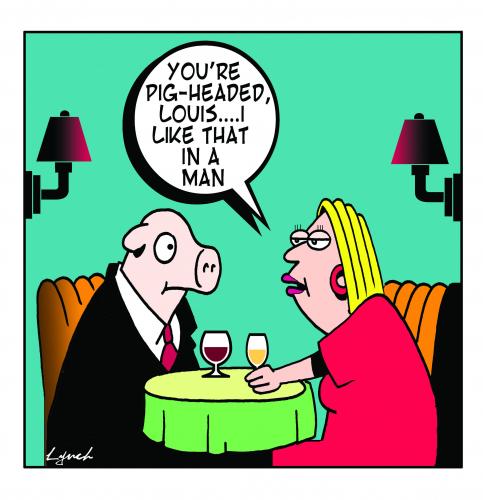
Today, I have a nice short entry for you about the adjective “pig-headed”. It has the same meaning as the word “stubborn”, except that it’s more negative. If you’re not sure what the word “stubborn” means, it is used when we want to talk about a person who makes a decision about something and then refuses to change their mind about it no matter what.  Let me give you some examples:

My father is so pig-headed! He refuses to go see a doctor even though he’s very sick! I don’t know what to do with him!

My daughter has been wearing the same jeans for over a week now! I tried to ask her to let me wash them, but she absolutely won’t do it! She’s so pig-headed!

I don’t think we will be able to get a better deal in the negotiations. I’ve heard that the president of the company is very pig-headed.

Generally, we don’t call ourselves “pig-headed” because it sounds very negative. However, it’s ok if we call ourselves “stubborn”. Also, you don’t want to call another person “pig-headed” directly to their face because they might get angry.

adjective: down-to-earth

DownToEarth (3)

Today I have a good adjective to describe someone’s personality – “down-to earth”. It is used to describe a person who doesn’t have any qualities that would make it difficult to talk to them. People who are “down-to-earth”  have a lot of common sense, and it’s easy for regular people to relate to them. For example:

I don’t like Jeremy anymore. Before he went to university, he was so down-to-earth and fun, but now he just talks about philosophy. I can’t relate to him at all now.

I would describe my husband as very down-to-earth. It’s easy to talk to him, so he has a lot of friends.

I really like Tom Hanks. Other actors seem really pretentious and conceited, but he seems really down-to-earth. I feel like he’s someone I could have a beer with.

I hope the meaning of this adjective is clear. It’s very commonly used to describe people’s personalities in English.

Next entries » · « Previous entries