Archive for November, 2010

grammatical expression: tell me about it

tell-me-about-it-600-sq

We have a few different ways to show agreement with someone else in English. Today’s expression “tell me about it” is one of them. We use it when we want to indicate to another person that we completely understand and agree with a statement they have just made. For example:

A: The summers in Tokyo are so hot and humid.

B: Tell me about it! I sweat like a pig every summer here.

________________________________________________________________

A: The new video game from ABC Company is terrible.

B: Tell me about it! I just bought it and I think it’s really boring.

________________________________________________________________

A: In high school, chemistry was so hard for me.

B: Tell me about it! It was my worst grade in high school.

So, as you can see from the examples, we use “tell me about it” to express the fact that we have had the same experience as the other person and we completely agree with them about it. Generally speaking, we use it when the first person has used an adjective to describe the situation as in the examples: “hot and humid”, “terrible” and “hard”.

adjective: down-to-earth

DownToEarth (3)

Today I have a good adjective to describe someone’s personality – “down-to earth”. It is used to describe a person who doesn’t have any qualities that would make it difficult to talk to them. People who are “down-to-earth”  have a lot of common sense, and it’s easy for regular people to relate to them. For example:

I don’t like Jeremy anymore. Before he went to university, he was so down-to-earth and fun, but now he just talks about philosophy. I can’t relate to him at all now.

I would describe my husband as very down-to-earth. It’s easy to talk to him, so he has a lot of friends.

I really like Tom Hanks. Other actors seem really pretentious and conceited, but he seems really down-to-earth. I feel like he’s someone I could have a beer with.

I hope the meaning of this adjective is clear. It’s very commonly used to describe people’s personalities in English.

grammatical word: sure

We Sure Can cover cropped

The word “sure” is generally an adjective that has the same meaning as “certain”. However, today I want to write about it as a grammatical word expression because of a certain way we use it as an adverb.

Sometimes in conversations when people reply to someone else’s statement or question, they want to emphasize the response to show some excitement or enthusiasm. We can use the word “sure” to do this. For example:

A: Can you help me with the ABC project tomorrow?

B: I sure can! What time do you want me to help you?

_________________________________________________________________

A: It’s a really nice day today, isn’t it?

B: It sure is! I love weather like this!

_________________________________________________________________

A: I hope you had a good time at the party last night.

B: I sure did! Thank you so much for inviting me!

_________________________________________________________________

A: Will you be going to the conference this weekend?

B: I sure will! I hope I’ll see you there!

_________________________________________________________________

A: I’m making Thai food for dinner tonight. Does your husband like spicy food?

B: He sure does! In fact, he loves it!

So, as you can see from the examples, the word that follows “sure” will change depending on the original question or statement. Please be careful to pay attention to which word you have to use. Generally speaking, it is the first word that the person uses: “will”, “can”, “did”, “do”, etc.

The reason why we use “sure” to emphasize the answer is because we want the other person to know that we are truly interested in what they are talking about. In English, if you simply say: “Yes, I can.”, “Yes, I will.”, “Yes, I did.” or “Yes, I do.”, it is considered to be a rather boring answer and indicates that we are not truly interested in the conversation. By using “sure” in the response, the other person will know for sure that you are interested.

By the way, using “sure” in this way is only used in non-formal situations. If you want to sound more formal, you can use the word “certainly” instead.

the difference between words: look, seem, sound, feel

when_things_seem_dvd

In English, we often use the words “look”, “seem”, “sound” and “feel” to describe our feelings about certain situations, but sometimes it is confusing as to which is the appropriate one to use in each situation. That’s what I’d like to write about today.

Let’s start with the easiest one: “look”. We use “look” when talking about something that we can physically see with our eyes. For example:

I saw a picture of Bill’s new house. It looks really nice.

This looks like a really expensive restaurant. I think we should go to another place.

We use “seem” when talking about a situation that we have experienced for a very short time and we want to give our impression of it. For example:

I only talked to the new manager for a couple of minutes, but she seems really nice.

I’ve only just arrived in this city, but it seems like a really good place to live.

We use “sound” when we are listening to another person talking about a certain situation and we want to talk about our impression of it. For example:

A: My new boyfriend is so sweet and romantic. Last night, he took me out for dinner to an expensive French restaurant.

B: He sounds wonderful.

________________________________________________________________

A: My new apartment has three bedrooms, a big kitchen and there’s a great view from the balcony.

B: It sounds like a great place.

Finally, we use “feel” when talking about the physical or emotional feeling something gives us. For example:

I love going to a hot spring. The hot water feels so good and relaxing.

I really like this restaurant. It feels like a place that I used to go to in my hometown.

So, as you can see from the examples, we can use these words by themselves or they can be followed by the word “like”. The difference is that we say “look” + adjective, and we say “look like” + adjective + noun or “look like” + noun. The same pattern is true for each of these words.

Sometimes, the pattern is a little different, especially when using “sound” or “look”. In these cases, the pattern is “It sounds/looks like” + noun + “be” verb + adjective. For example:

A: I have to work overtime until 11:00 p.m. every night, and sometimes I work on the weekends too.

B: It sounds like your job is really tough.

Did you see the reading list for this course? There are so many books on it! It looks like this course is not going to be easy.

idiom: to (not) see eye to eye

12646516_0a15_625x1000

In my very first blog, I mentioned today’s idiom briefly, but it’s a very common expression so I’d like to go over it again in more detail today. The expression is to not “see eye to eye” with someone. It is used when we want to talk about not agreeing with someone. It is usually used in the negative. For example:

My boss and I don’t see eye to eye about where to open the new branch.

Last night, my friend and I didn’t see eye to eye about what to eat for dinner.

My sister and brother never see eye to eye about what to watch on TV.

My husband and I don’t see eye to eye about movies. He likes action movies and I like comedies.

As I mentioned, this expression is usually used in the negative, but sometimes it can be used in questions. For example:

A: Do you and your husband always see eye to eye about everything?

B: No, of course not!

Sometimes, it’s possible to use it in a positive sentence, but these cases are much less common. For example:

I’m glad we see eye to eye about this project.

As you can see, we use the preposition “about” when talking about the topic that the two people either agree or disagree about, and we use “with” when talking about the person that the person agrees or disagrees with.

intransitive phrasal verb: peter out

1302518515_logo_peter_out

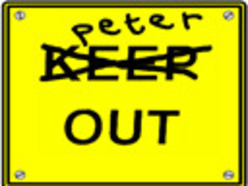
I have another intransitive phrasal verb for you today, and it is “peter out”. Normally “Peter” is a man’s name, and we don’t use it as a verb except in the case of the phrasal verb “peter out”. It is used when we want to talk about something becoming less and less until it gradually stops. For example:

The applause slowly petered out after the band left the stage.

At first, everyone had a lot of enthusiasm for the project, but it eventually petered out when they found out how much work it was.

We had many customers when we first opened our store, but they have really petered out since the shopping mall was built down the street.

I think interest in our product is petering out. Maybe it’s time we started to advertise it again.

We often use this expression when talking about positive emotional responses such as enthusiasm, interest, excitement, etc. We DON’T use it when talking about something negative gradually stopping.

grammatical expression: out and out

OutAndOut

Today’s expression is “out and out”, and it has the same meaning as “completely” or 100%. Let me give you some examples of how to use it.

My neighbor is out and out crazy. He believes that there are aliens in the city walking around disguised as humans.

That company has been using child labor to manufacture its products. It’s out and out unethical.

Georgio’s is out and out the best Italian restaurant I’ve ever been to.

You told me that you were having dinner with your father, but I called him and you weren’t with him! That was an out and out lie!

We usually use this expression with adjectives, as in the first three examples. However, sometimes it can also be used with a noun, as in the last example.

We use it with adjectives that describe our view or opinion of a situation or person. We don’t use it with adjectives that describe something physically. So, we CAN’T say, “My apartment is out and out small.” We also don’t use it with adjectives like “good” and “bad”, but we can use it with “the best” or “the worst”.

adjective: picky

?????????????????????????

The adjective for this week is “picky”. It is used to describe people who are hard to please about something, so they are very selective about it. For example:

My best friend is such a picky eater. There are so many things that he refuses to eat.

Evelyn is extremely picky when it comes to men. That’s why she’s usually single.

I’m very picky about the people that I hire for my company. They must all be well-educated and have a good personality.

We can also use “picky” to talk about someone who is very focused on the details of a situation. For example:

My French teacher is very picky. She corrects even the smallest mistakes that the students make.

When you make your business cards, make sure you select a good font. Some people think it’s a picky detail, but I think it’s very important.

In the case of the second meaning of “picky”, we can use it to talk about the person or the detail. However, in the first meaning, we only use it to talk about the person. In both cases, the word is a little negative in tone. We can say, “I’m picky.” and that’s ok because we are talking about ourselves, but if we say, “You’re picky.”, it’s a little rude and some people might get upset.

grammatical word: buy

index

Today I have another verb for you that has an unexpected second meaning: “buy”. Of course, everyone knows the first meaning which is to purchase something with money. However, there is a second meaning which is also commonly used. This second meaning is to believe something that another person tells us. For example:

Janice told me she had to cancel our date last night because she was working, but I don’t buy it.

A: Did your father buy your story about coming out to study with your friend?

B: Yeah, he bought it. Now where do you want to go for our date?

Fred is really innocent and naive. He’ll buy anything anyone tells him.

When we use “buy” in the sense of believing someone, we never use a person as the object of the sentence. So, we would say, “My friend didn’t buy it.” (“it” means the story), but we DON’T say, “My friend didn’t buy him.” (“him” means the person who told the story). However, if we use the word “believe”, we could use either “it” or a person. For example:

I told my friend that my father is a famous actor, but she didn’t buy it.

I told my friend that my father is a famous actor, but she didn’t believe it.

I told my friend that my father is a famous actor, but she didn’t believe me.

the difference between words: little and a little, few and a few

index

Many of my students complain about articles (a/an, the) because they don’t exist in Japanese as well as in many other languages. This makes them very difficult to learn and many people don’t try to use them because they think they’re not important for basic communication. This is true in many cases, but sometimes they are extremely important and are necessary for effective communication. Today’s blog is about the difference between “little” or “few” and “a little” or “a few” and, in these cases, the “a” is very important!

We use “little” or “few” when we want to say there is not a lot of something; that the amount of something is very small. We use “a little” or “a few” when we want to say there is a certain amount of something which is a little smaller than saying there is “some” of it. Therefore, “little” or “few” sounds much more negative than “a little” or “a few”, and they indicate a much smaller amount of something.

Also, you should note that we use “little” and “a little” for uncountable nouns, and we use “few” and “a few” for countable nouns. For example:

Little of my knowledge comes from reading books; most of it has come from watching TV.

I have very little experience with computers. I only got my first computer two months ago!

Few people in my school are from foreign countries. I would say 99% of us were born in this country.

In Canada, few companies allow the employees to smoke inside. Most of them make people go outside to smoke.

We have a little beer in the fridge, so you can have some if you like.

I have a little time at 3:00 if you want to talk about the project then.

If you’re looking for a place to live, my building has a few empty apartments. You should come and check them out.

There are a few really good Indian restaurants in my city. I really enjoy going to them.

So, as I mentioned already we use “little” and “few” in situations which are more negative. Basically “little” is the same thing as “not much”, and “few” is the same thing as “not many”. If you want to think of them as being on a scale, it would be as follows:

none -> almost none -> few/little ->a few/a little -> some -> many/much/a lot of -> most -> almost all -> all

Next entries » · « Previous entries