Archive for November, 2010

idiom: to be on its last legs

dishwasher-repair

If you’ve ever  kept an old machine of some kind for a long time, today’s idiom will probably be useful for you. The idiom is for something to be “on its last legs”. This expression is used when we want to talk about a machine which is old and in poor condition and very close to breaking down completely. For example:

My TV set is about 20 years old, and it hasn’t been working well recently. I think it’s on its last legs.

This computer is on its last legs. We’re going to have to buy a new one soon.

Our dishwasher finally broke down completely last night. It had been on its last legs for a while, so I wasn’t surprised.

I think the reason we use this idiom with machines is because we often say that a machine “runs” on electricity or on some other source of power. Traditionally, if something is running, it must have legs to do that with. Therefore, if something will stop running soon, its “legs” are losing power. That is just my guess, but it could be a useful way to remember this idiom.

intransitive phrasal verb: back down

Never_back_down

The phrasal verb I have for you this week is “back down”. It is intransitive which means that it doesn’t take an object. It is used when we want to talk about a person who gives up trying to win an argument or challenge with another person. For example:

Jason never wins an argument because he always backs down if you challenge him.

Whenever someone wanted to fight my brother in high school, he backed down immediately. He really hates fighting.

The strike continued for a long time because both the company and the employees refused to back down. In the end, the company backed down first.

I hate debating things with Tom. Once he starts arguing about something, he never backs down.

This expression can be used in any situation because it’s neither formal nor casual.

grammatical expression: not that…

einstien-quote

I have another very common expression that I’d like to write about today. This is another one that English speakers use all the time in conversation but, as far as I know, nobody ever teaches it. It is “not that” followed by a particular sentence. It is used when we say something to another person and then we think they may have gotten the wrong idea about us based on that statement. We say “not that” followed by another sentence to make sure they didn’t misunderstand what kind of person we are. For example:

Sometimes I play video games, not that I’m a computer geek or anything like that!

I went to see a French movie with my girlfriend, not that I like foreign films. She made me go with her!

I work a lot of overtime for my job, not that I want to. I have no choice.

I memorized all the Chinese characters and their meanings in this book, not that it was easy for me. It took me a long time to do it.

My husband has agreed to help me with the party, not that he had a choice. I told him I wouldn’t cook for him unless he helped me.

So, in these examples, the statement that follows “not that” indicates that I’m not a computer geek, I don’t like foreign films, I don’t want to work overtime, memorizing the Chinese characters was not easy for me, and that the husband didn’t have a choice about helping with the party. As I mentioned at the beginning, the person says these things to ensure the other person doesn’t misunderstand.

This is a very common expression. If you haven’t heard it before, I hope you’ll now be able to notice when English speakers use it.

adjective: hot

index

In English, the adjective “hot” has many meanings which are often used in casual conversation. Let me go over the commonly used meanings for you in today’s blog.

1. for the weather to have a high temperature. For example:

It’s really hot today. It must be at least 40 degrees!

I don’t like hot weather very much, so I don’t enjoy the summers here.

2. for an object or food to have a high temperature. For example:

Don’t touch that pot with your bare hands. It’s really hot and it could burn you.

The soup is really hot because it just came off the stove. I need some water.

3. for some food to be very spicy. For example:

Those peppers are extremely hot, so I wouldn’t eat them if I were you.

Korean food is really hot and spicy, but I love it!

4. for something or someone to be very popular at the moment. For example:

Peter Nelson is one of the hottest young actors in Hollywood now! His last two movies were very successful.

The AB-40 computer system from ABC Computers is very hot right now! Everyone wants to get one!

5. for a person to be very sexy and attractive. For example:

Look at that girl over there! She’s so hot! I’m going to go over and talk to her.

Jayne’s boyfriend is really hot! She’s such a lucky woman!

6. to experience a lot of good luck when playing a game. For example:

I’ve won $700 at the casino so far! I’m really hot tonight!

I am hot at this game today! I’ve won every game so far!

7. something that has been stolen. For example:

A guy offered to sell me a car really cheaply, but I didn’t buy it from him. I have a feeling that it’s hot.

Pawn shops probably have a lot of hot items. I think a lot of thieves steal things and then pawn them as soon as possible.

All of these meanings are commonly used, but the last one about stolen items is probably the least commonly used in everyday conversation. However, this is the type of language that we often hear in movies or on TV shows.

grammatical word: snowball

snowball

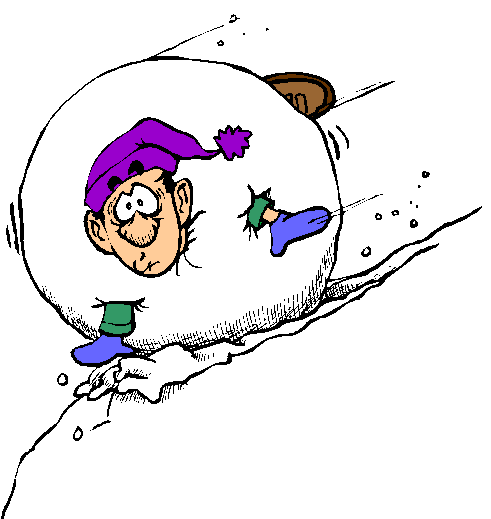
Being from Canada, I’m very familiar with snowballs. When I was young, my friends and I used to have snowball fights. This was a normal thing growing up in a cold country. Of course, usually the word “snowball” is a noun, but sometimes it can be used as a verb. That is what I’d like to write about today.

The verb, to “snowball” means for a situation to get bigger and bigger as time goes by. The reason the word “snowball” is used is because if we make a small snowball and roll it down a hill of snow, more snow will stick to it, and it will become much larger. Let me give you some examples of how to use “snowball” as a verb:

I made the mistake of offering to help a guy at my office with his report. Since then, the situation has completely snowballed. Now many of my co-workers are asking me for my help all the time!

I gave my son a Pokemon toy for his birthday, but now I regret doing that. It started off as one toy, but now the situation has totally snowballed. He has started collecting the toys, and now he wants a new one every week!

My friend started to write a short story about his family but soon after that, it really snowballed. He ended up writing a 400 page book about them.

The verb “snowball” is almost always used in the past tense and is usually used to describe negative situations that have gotten bigger and bigger over time. However it can be used to describe neutral situations as well, such as with the last example about the story becoming a book.

the difference between words: later and soon

later

Sometimes my students get confused about when to use “later” and when to use “soon”. This is especially confusing for them with the expressions, “See you later.” and “See you soon.” So I’d like to go over this in my blog today.

The word “later” is used to talk about a future time, but we don’t know exactly when in the future it will be. However, when we say “later”, it sounds like it will not be in the immediate future. The word “soon”, on the other hand, is used when something will happen in the immediate future, and usually the person has a general idea of when it will happen. For example:

A: I had a really nice time with you tonight. Let’s go out again sometime.

B: Ok. I’ll see you later. Bye.

_________________________________________________________________

A: We’re going to take a ten minute break now, and then we can finish talking about the project.

B: Ok, see you soon.

I don’t have time to write the report now, but I’ll do it later. I have lots of time because the deadline isn’t until next month.

I don’t have time to write the report now, but I’ll do it soon. The deadline is this Friday.

So, in the first example, the person says “See you later.” because they don’t know exactly when they will see the other person. The expression, “See you later.” is a friendly, casual way to say goodbye to someone. In the second example, the person says “See you soon.” because they know they will see the other person after a short time has gone by – in this case, after ten minutes.

In the third example, the person uses “later” because they don’t know exactly when they will write the report, but they know they have a fairly long period of time in which to do it. In the fourth example, they use “soon” because it must be done in the immediate future – in this case, before Friday.

Next entries »