Archive for May, 2011

grammatical expression: the more the merrier

https://i0.wp.com/fc03.deviantart.net/fs71/i/2010/233/d/b/The_MORE_the_MERRIER___Desktop_by_C2SilvaRymes.png

I was recently in a conversation with someone, and I used today’s grammatical expression: “the more the merrier”. I thought it would make a good entry for today. We use it when someone asks if another person can come to a planned event such as a party. We say “the more the merrier” in response, and it means that the other person is welcome to come: In other words, the more people at the event, the better it will be. For example:

A: Is it ok if I bring my girlfriend to the party?

B: Sure!  It’s totally ok! The more the merrier!

__________________________________________________________________

A: I wasn’t invited to go drinking after the meeting. Do you think it’s alright if I come?

B: Of course it’s alright! The more the merrier! Please tell other people to come too!

__________________________________________________________________

A: I really want to go to Doug’s party, but I don’t know if I should.

B: I’m sure he’d love for you to come! The more the merrier!

So, in the expression, we use the word “merry” which is another word for “happy”. However, we don’t use “merry” very much in modern English. It’s only used in special expressions such as this one, or at Christmas time when we say “Merry Christmas”.

adjective: jumpy

https://i0.wp.com/www.at-toledo.com/startle.jpeg

Today’s adjective is “jumpy”, we use it when we want to talk about people who are startled easily. If you don’t know, the verb “startle” means to cause another person to jump up in surprise and fear. For example:

I don’t like going to horror movies with my girlfriend because she’s so jumpy.

Don’t touch Betty if she has her back to you. That girl is really jumpy, and she’ll probably scream.

A: Oh my God! You scared me so much. Please knock before you enter my room.

B: Don’t be so jumpy! I just wanted to talk to you.

I used to be really jumpy as a kid, but I don’t get startled so easily anymore.

I shouldn’t drink so much coffee. It makes me jumpy.

As you can see, it’s very common to use the words “really” or “so” with this adjective.

grammatical word: get (part two)

https://i0.wp.com/vercors.univ-savoie.fr/ressourcesenligne/cours_hh/new/LEA_L%26amp%3BC2/L%26amp%3BC2_10/get_cold.JPG

Today, I want to continue with the verb “get”, and write about more of its many meanings.

8. to catch a minor illness such as a cold or the flu. For example:

I got a cold yesterday, so I’m not going to work today.

Many people are getting the flu these days. I hope I don’t get it too.

9. to retrieve something for another person. For example:

Can you get my sweater for me? It’s in the bedroom.

My son forgot his backpack at school, so I have to go and get it now.

10. to receive a punishment in a court of law. For example:

The man who killed his wife got the death penalty.

My neighbor was selling drugs. He got one year in prison for it.

11. to be able to hear something. For example:

I’m sorry, but I didn’t get your name because it’s so noisy in here. What is it again?

I got the man’s first name, but I didn’t get his last name. He was speaking so softly.

12. to cause something to be in a different condition. For example:

We have to get the apartment clean before the guests come over.

The children were playing in the mud and got their clothes all dirty.

13. to arrange for another person to do something for you. For example:

I’ll get my wife to buy some wine before she comes home.

I’ll get my secretary to send the package to you later today.

14. to affect someone emotionally. For example:

I don’t usually cry at movies, but that particular movie really got me.

It really gets me when I see my husband holding our new baby. He looks so proud!

15. for someone or something to start to become in a certain condition. For example:

It’s getting really cold these days. I need to buy a warmer coat.

I’m getting really angry with my boss! Lately he’s been making me work overtime and doesn’t even say thank you!

As I mentioned last week, I think the best way to learn words such as “get” is to focus on the sentences. You should memorize the full sentence and then change the small details. In this way, you can learn how to speak naturally.

Next week, I’ll continue with more ways to use “get”.

the difference between words: surprised and shocked

https://englishhelponline.me/wp-content/uploads/2011/05/surprisedlady4.gif?w=300

The entry for today is about two words that many of my students get confused about: “surprised” and “shocked”. We use “surprised” when we want to talk about a situation that we find unexpected. It is generally a positive or neutral situation. On the other hand, we use “shocked” when we want to talk about a situation that we find extremely unexpected. These situations are usually negative but sometimes they can be neutral. The important thing to remember is that “shocked” is much stronger than “surprised”. For example:

I thought Jenny was about 30, but she’s really 41. I was quite surprised.

I thought Jenny was about 30, but she’s really 56! I was shocked!

I was surprised when I found out that Bill got a promotion after working at the company for only two years.

I was shocked when I found out that Bill got a promotion after working at the company for only five months!

These are examples of neutral situations. We use “surprised” in the first sentence because we feel it was a little unexpected, but we use “shocked” in the second sentence because it was very unexpected. Here are some more example sentences:

I was really surprised when my husband remembered my birthday. He usually forgets it.

I was pleasantly surprised when Gerry came to my party. He is usually too busy to come to my parties.

I was totally shocked when I found out that my boss died from a heart attack! He was only 52 years old!

Yesterday, my company announced that at least 100 employees would have to be laid off. Everyone was so shocked because we thought the company was doing well.

Here, the first two sentences use “surprised” in positive ways, and the last two examples use “shocked” because the situations are very serious and negative.

Please remember that we use the -ed forms, “surprised” and “shocked” when we are talking about people’s feelings about a situation. We use the -ing forms, “surprising” and “shocking” when we want to talk about a situation itself. For example:

It was so surprising when Bill got a promotion after only working at the company for two years.

There was a huge tsunami in Japan recently. It was shocking to see the terrible destruction it caused!

Please note that in these cases, we use the word “it” with the -ing forms.

idiom: not by a long shot

https://englishhelponline.me/wp-content/uploads/2011/05/stormnotover2.jpg?w=202

Today’s idiom is “not by a long shot”, and it is used when we want to talk about a competition between two or more people or groups and we think one of them has no chance of winning. For example:

A: Do you think the Giants will win the baseball game against the Red Sox?

B: No, not by a long shot! The Red Sox are a much better team, and they’ve won every game this season!

_________________________________________________________________

A: Do you think Colin will get the promotion?

B: Not by a long shot! He’s only been working here for a year, and he still has a lot to learn.

The new movie directed by Sam Peters is nominated for Best Picture at the Oscars, but it won’t win by a long shot.

I’m going to play tennis with my friend this afternoon, but she used to be a professional player, so I won’t win by a long shot.

As you can see from my examples, we can either use this expression as a response to someone’s question, as in the first two examples, or we can make a sentence with it using “won’t win by a long shot”.

In this expression, I think “long shot” represents a slight chance of winning, so when we say “not by a long shot”, we mean that even a slight chance of winning doesn’t exist.

We can also use it when we want to say that a certain situation is not even close to being finished yet. For example:

A: Do you think the storm is over now?

B: Not by a long shot! These storms usually last for at least 12 hours.

_________________________________________________________________

A: Do you think your mother is finished being mad at you?

B: Not by a long shot! She’ll stay angry for at least another three or four days!

I may not have gotten promoted yet, but this isn’t over, not by a long shot! I’ll keep working hard until I get a promotion.

My daughter asked me to buy her a computer. I said no, but I know her and this isn’t over by a long shot. She’ll keep asking me until I say yes.

Again, this expression can be used as a response, as in the first two examples, or in a separate sentence, as in the last two examples.

In this case, “long shot” represents the chance that something is over. So, in this case, the expression means that there is no chance that something is over.

separable phrasal verb: mull over

https://vbschools.schoolnet.com/files/user_images/eds/crs/thinking%20web%20pic.jpg

The phrasal verb for this week is “mull over”, and it is used when we want to talk about thinking about an idea before making a decision about doing it or not. For example:

Thanks for telling us about your proposal. We’ll mull it over and let you know what we decide.

Right now, my wife and I are mulling over whether or not to move to another city.

I’m not sure if I should take this job or not. I’ll have to mull it over for a little while.

Don’t make a decision right now. Just mull it over and let me know later.

We can use this phrasal verb in any situation, but it’s very commonly used when talking about business decisions. The word “mull” has the meaning of thinking about something, but we never use it alone; it is always used with the word “over”.

grammatical expression: second to none

https://i0.wp.com/www.explosionspiritwear.com/designs/l/1224092667illBeSecondToNone.jpg

The other day I was reading an article on the Internet, and in it I saw the grammatical expression for today: “second to none”. We use this expression to talk about things which are the best in our opinions. In other words, according to us, they are number one. For example:

The apple pie at this restaurant is second to none. I highly recommend it!

When it comes to cooking, my wife is second to none.

For Canadians, hockey is a sport which is second to none.

Of all the books I’ve read, Midnight’s Children is second to none.

As I mentioned in a recent blog, when North Americans say “hockey”, it means ice hockey. When other people say “hockey”, they mean field hockey.

In my last example, I mention the novel Midnight’s Children by Salman Rushdie. This is my personal favorite book of all time, but that is my opinion. Other people may not agree. Therefore, when I say it’s “second to none”, it means that it’s number one for me.

adjective: intense

https://i0.wp.com/islamiclearningmaterials.com/wp-content/uploads/2011/01/cold-winter.jpg

The adjective for today is “intense”, and it is used to talk about something which is very strong and concentrated. It can be used to talk about various things such as an emotional situational, temperature, work, someone’s personality, etc. For example:

My new boss is a very intense person! He’s so serious! I don’t think he ever smiles or laughs.

I spent the winter in Calgary last year, and the cold was intense! I’d never felt so cold in my life!

The last scene in that movie where the killer was revealed was intense! I want to see it again!

I went to the gym and had a really intense workout with my trainer. I’m really tired, but I’m glad I did it.

The schedule for my tour was intense. We traveled to four different countries in Europe in one week!

Sometimes the word “intense” is used in negative ways, as in examples one and two, and sometimes it can be used in more positive ways, as in examples three and four. Example five is more neutral in tone.

grammatical word: get (part 1)

https://englishhelponline.me/wp-content/uploads/2011/05/6a00d83451bd1369e2010535e37b76970c-800wi.jpg?w=300

As you probably know, the verb “get” in English has many meanings and uses. I would like to go over some of them in my blog today. Since there are so many ways to use it, I will continue writing about “get” next Tuesday as well. Let me go over some of the ways to use it for you:

1. to receive something. For example:

I got a new bike for my birthday. My parents gave it to me! I’m so happy!

My friend got a big promotion at work. I have to call and congratulate him.

2. to give something to someone. For example:

I’m going to get my wife some flowers for our anniversary.

My mother got me a really nice sweater for my birthday.

3. to go and obtain something by buying or borrowing it. For example:

I’m going to get some food at the supermarket. Do you need anything?

Paul said I could borrow his CD player, so I’m going to go and get it now.

4. to obtain something after requesting it from a person of higher status. For example:

I got permission from my parents to go to the concert.

I got the day off on Friday from my boss, so we can leave early for our camping trip.

5. to arrive at a destination. For example:

I always get to work before 9:00 a.m. every morning.

What time did you get home last night?

6. to reach someone on the telephone. for example:

I can’t get Mr. Lawrence on the phone right now because he’s in a meeting.

I’m sorry, but you won’t be able to get Jack on the phone until Monday. He’s on vacation right now.

7. to understand something. For example:

My friend told a joke today. Everyone else laughed, but I didn’t get it.

A: So, that’s what you need to do to operate this machine. Do you understand?

B: Yes, I got it.

These are the first seven ways we commonly use the word “get”. As I mentioned before, I will continue with this next week.

I know that it can be confusing when we use one word in so many different ways. My advice is to memorize the sentences that I’ve given you and then change the small details. That should make it easier for you to use them properly without becoming confused.

the difference between words: umpire and referee

https://i0.wp.com/www.printactivities.com/ColoringPages/Baseball-Coloring-Pages/Baseball-umpire-02.gif

https://i0.wp.com/forum.smartcanucks.ca/attachments/expired-repost-not-valid-canada/20550d1269635361-last-poster-wins-5-game-over-referee.jpg

A little while ago one of my readers asked me about the difference between “umpire” and “referee”, so that is what I’ll write about today.

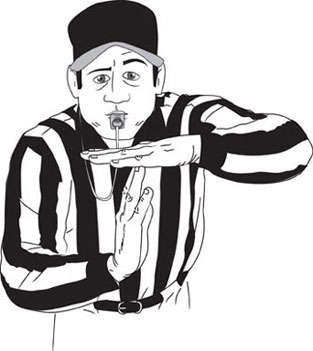
Both words are used to talk about the person who decides if a particular play in a sport is good or bad. However, the word “umpire” is only used in cricket or baseball while “referee” is used in other sports such as football, soccer, hockey, etc. Here are some examples:

The umpire ruled that it was a foul ball.

The umpire at the baseball game said that Ron Jones was out, but I totally disagree. I saw the play, and I think he was safe.

According to the referee at the game, the goal didn’t count. A lot of fans were really angry at him.

The referee gave that hockey player a penalty for high sticking.

As you probably know, different countries have different words for certain sports. In Canada and the United States, we say “soccer” and “hockey”, but in other parts of the world like in Europe and Australia, they say “football” and “ice hockey”. In those parts of the world, when they say “hockey”, North Americans say “field hockey”. Because I’m from Canada, the words I used in my blog are North American based.

Next entries » · « Previous entries